1887–1889 · 3 works · Art Institute of Chicago · The Metropolitan Museum of Art
Van Gogh: Three Encounters
Stop 1 of 3 · Vincent van Gogh · 1887
Self-Portrait with a Straw Hat
First Look
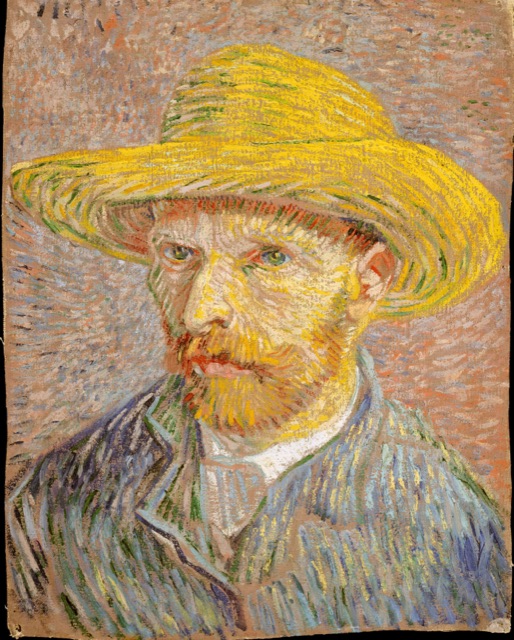
Look closely at the marks that build the face. Van Gogh painted this portrait in Paris in eighteen eighty-seven, when he was experimenting with color and short, separate strokes. Using himself as a model helped him keep painting when money was scarce. The canvas also holds an earlier peasant study on its other side. That unseen painting is part of this object’s history.
Painted in Paris, this self-portrait uses short strokes and contrasting colors. Van Gogh painted it on the reverse of an earlier study.
Stop 2 of 3 · Vincent van Gogh · 1888
The Flowering Orchard
First Look
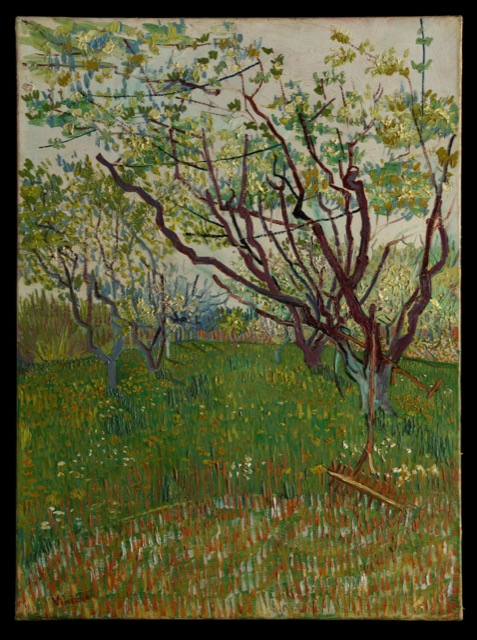
Let your eyes follow the long, angular branches. The Metropolitan Museum relates their shape to Van Gogh’s admiration for Japanese prints. He painted this orchard during his first spring in Arles, in eighteen eighty-eight. Beneath the trees are a rake and a scythe. Those small objects suggest a gardener’s work, even though no person appears in the scene.
Van Gogh painted this orchard during his first spring in Arles. The branching forms reflect his interest in Japanese prints; the tools hint at the people tending the trees.
Stop 3 of 3 · Vincent van Gogh · 1889
The Bedroom
First Look
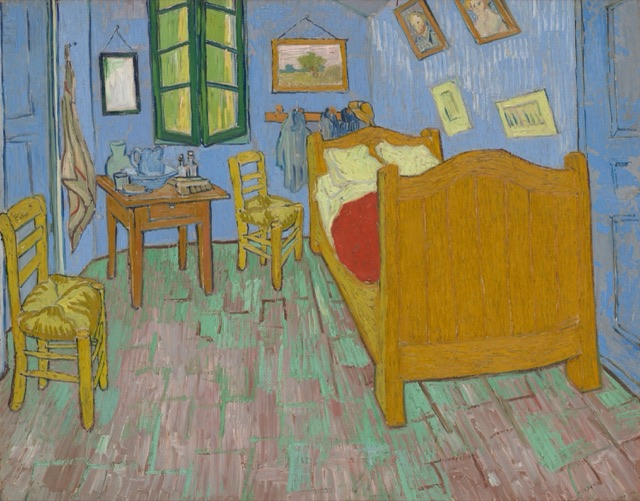
Look at the floor, and how steeply it tilts toward you. Everything in this room leans a little. It is Vincent van Gogh’s bedroom in the Yellow House at Arles, in the south of France. He painted it three times, and this is the second version, from eighteen eighty-nine. The colours are strong and the lines are sharp. Yet Van Gogh meant the picture to express utter repose.
A closer look
Notice that nothing in the room casts a shadow. Van Gogh left shadows out on purpose, and laid the colour on in flat, thick areas. He described the first version in a letter to his brother Theo, colour by colour: walls of pale lilac, a floor of broken and faded red, a bed and chairs of chrome yellow, a blood-red bedspread, an orange table, a blue basin, a green window. He had moved into the house in September eighteen eighty-eight, hoping other painters would join him there, and he painted that first bedroom a month later. This second version was made nearly a year afterwards, in September eighteen eighty-nine, when he was living at Saint-Rémy. At the same time he painted a third, smaller one as a gift for his mother and sister. Look at the two portraits hanging above the bed. In each version of the bedroom, the pictures on the wall are different.
Van Gogh’s own bedroom in the Yellow House at Arles: a wooden bed, two chairs, a small table, pictures on the walls. He painted the room three times. This is the second version, made in September 1889, nearly a year after the first. Oil on canvas, 73.6 × 92.3 cm.
1887Self-Portrait with a Straw Hat
Painted in Paris, this self-portrait uses short strokes and contrasting colors. Van Gogh painted it on the reverse of an earlier study.
1888The Flowering Orchard
Van Gogh painted this orchard during his first spring in Arles. The branching forms reflect his interest in Japanese prints; the tools hint at the people tending the trees.
1889The Bedroom
Van Gogh’s own bedroom in the Yellow House at Arles: a wooden bed, two chairs, a small table, pictures on the walls. He painted the room three times. This is the second version, made in September 1889, nearly a year after the first. Oil on canvas, 73.6 × 92.3 cm.
Other exhibitions
The Sistine Chapel: Ceiling, Altar, and Wall Cycles
Michelangelo’s ceiling and Last Judgment alongside the fifteenth-century north and south wall narratives by Botticelli, Perugino, Ghirlandaio, Rosselli, and Signorelli.
1765–1857 · 7 worksEdo: Pictures of the Floating World
Seven woodblock prints from the city of Edo, 1765 to 1857: Harunobu, Kiyonaga, Sharaku, Utamaro and Hiroshige, from the Art Institute of Chicago.
1867–1893 · 7 worksImpressionism: Painters of Modern Life
Seven painters and seven views of modern France, 1867 to 1893: Monet, Renoir, Morisot, Caillebotte, Degas, Cassatt and Pissarro, from the Art Institute of Chicago.
1782–1893 · 6 worksFrom Edo to Paris: Ukiyo-e and the Impressionist Eye
How Japanese woodblock masters Hiroshige and Kiyonaga inspired the cropped framing, asymmetric diagonals, and rain-swept streets of Caillebotte, Degas, and Cassatt.