Self-Portrait with a Straw Hat
Stop 1 · First look
First Look
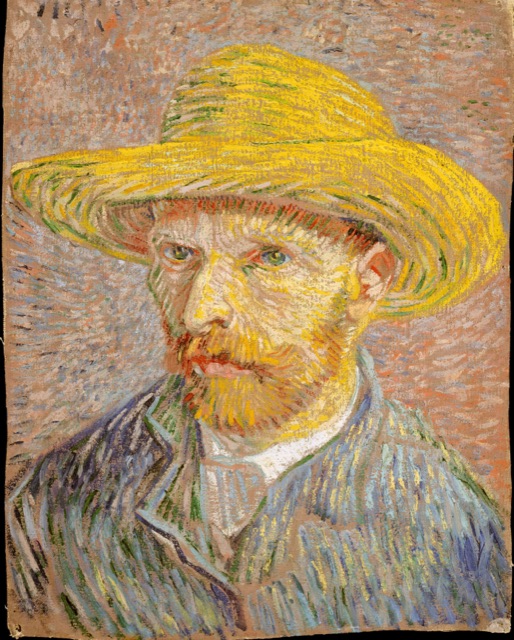
Look closely at the marks that build the face. Van Gogh painted this portrait in Paris in eighteen eighty-seven, when he was experimenting with color and short, separate strokes. Using himself as a model helped him keep painting when money was scarce. The canvas also holds an earlier peasant study on its other side. That unseen painting is part of this object’s history.
Stop 2 · Museum record
Catalog Summary
Painted in Paris, this self-portrait uses short strokes and contrasting colors. Van Gogh painted it on the reverse of an earlier study.
Recorded physical scale: 31.8 × 40.6 cm (12.5 × 16.0 in · 0.32 × 0.41 m).
Stop 3 · Historical Context
Vincent van Gogh (1853–1890)
Dutch painter who, in ten years of work, used strong colour and thick, visible brushstrokes to put feeling into landscapes, portraits and still lifes.
Post-Impressionism (about 1886 to the early 1900s): A later name for painters, chiefly Cézanne, Gauguin, Seurat and Van Gogh, who started from Impressionism around 1886 and each took it somewhere different.
First Look
Look closely at the marks that build the face. Van Gogh painted this portrait in Paris in eighteen eighty-seven, when he was experimenting with color and short, separate strokes. Using himself as a model helped him keep painting when money was scarce. The canvas also holds an earlier peasant study on its other side. That unseen painting is part of this object’s history.
Catalog Summary
Painted in Paris, this self-portrait uses short strokes and contrasting colors. Van Gogh painted it on the reverse of an earlier study.
About the Artist
Vincent van Gogh (1853–1890)
Vincent van Gogh was born in Zundert, in the south of the Netherlands, the son of a pastor. He worked for an art dealer, taught in England and preached to coal miners in Belgium before deciding, at 27, to become an artist. He largely taught himself, beginning with dark pictures of farm workers such as The Potato Eaters.
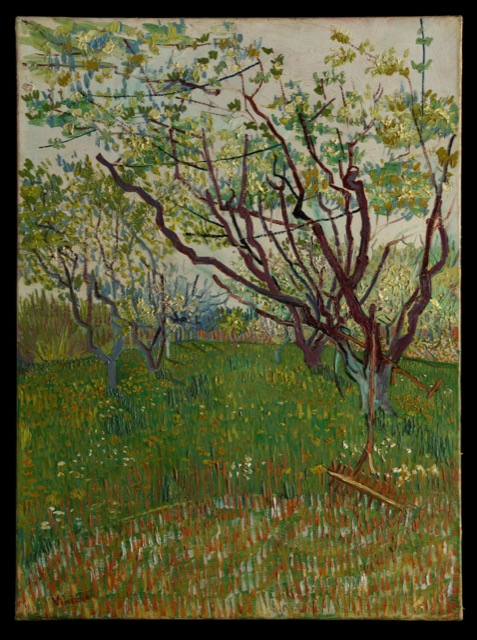
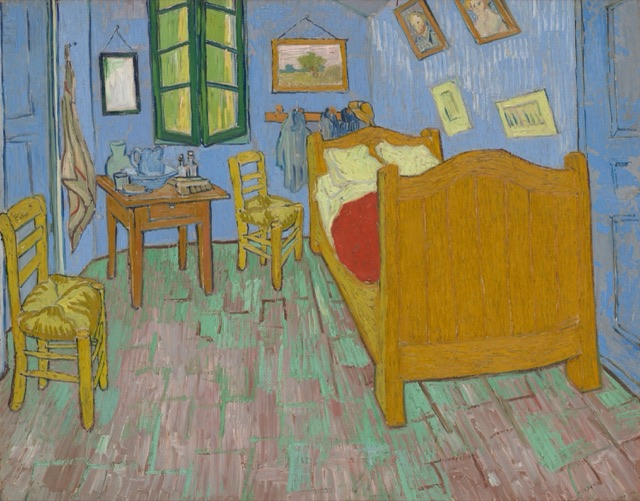
In 1886 he joined his brother Theo in Paris, where the work of Claude Monet and other modern painters brightened his colours. He answered the dotted technique of Georges Seurat with small, even strokes of his own, collected Japanese woodblock prints, and in 1887 painted copies after Hiroshige. In February 1888 he moved to Arles, in the south of France, and painted orchards in blossom, his bedroom and the Sunflowers.
After a crisis in which he cut off his ear, he spent a year in a hospital at Saint-Rémy and made about 150 paintings there. In May 1890 he moved to Auvers-sur-Oise. On 27 July he shot himself, and he died two days later, aged 37.