Wheat Field with Cypresses
Stop 1 · First look
First Look
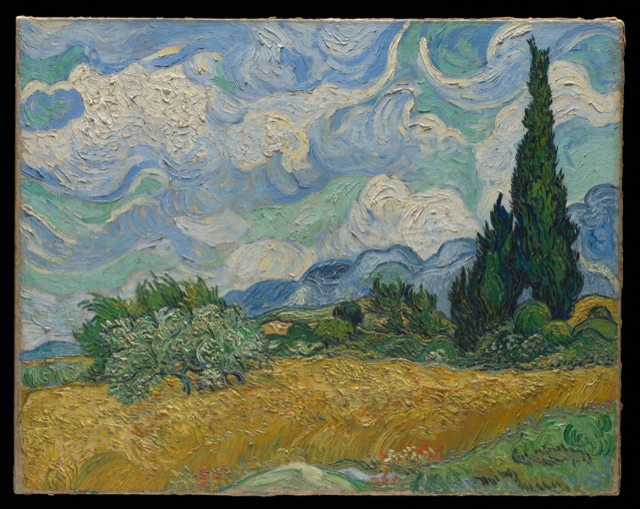
Look at the two dark cypresses on the right, and then at the clouds. Everything is drawn with the same rolling line. Vincent van Gogh painted this field near Saint-Rémy, in the south of France, in the summer of eighteen eighty-nine. The wheat is ripe and yellow, and the wind is strong. He thought this one of the best landscapes he made that summer.
Stop 2 · Technique
Closer Reading
Notice how thick the paint is, above all in the clouds and the wheat. Van Gogh worked outdoors in front of the field, and he laid the paint on in heavy, curling strokes that still stand up from the canvas. He was living in an asylum at Saint-Rémy, where he had gone of his own accord in May eighteen eighty-nine, and when he was well he was allowed to paint in the country around it. The cypresses fascinated him. He wrote that they were as beautiful in line and proportion as an Egyptian obelisk, and he was surprised that nobody had yet painted them as he saw them. He liked this picture enough to repeat it. That September, in the studio, he made a second version of the same size, now in the National Gallery in London, and a smaller one for his mother and sister.
Stop 3 · Museum record
Catalog Summary
A field of ripe wheat bends under a wind that also drives the clouds, with two dark cypresses standing against the sky at the right. Van Gogh painted it outdoors near Saint-Rémy in the summer of 1889 and counted it among his best summer landscapes. Oil on canvas, 73.2 × 93.4 cm.
Recorded physical scale: 93.4 × 73.2 cm (36.8 × 28.8 in · 0.93 × 0.73 m).
Stop 4 · Historical Context
Vincent van Gogh (1853–1890)
Dutch painter who, in ten years of work, used strong colour and thick, visible brushstrokes to put feeling into landscapes, portraits and still lifes.
Post-Impressionism (about 1886 to the early 1900s): A later name for painters, chiefly Cézanne, Gauguin, Seurat and Van Gogh, who started from Impressionism around 1886 and each took it somewhere different.
First Look
Look at the two dark cypresses on the right, and then at the clouds. Everything is drawn with the same rolling line. Vincent van Gogh painted this field near Saint-Rémy, in the south of France, in the summer of eighteen eighty-nine. The wheat is ripe and yellow, and the wind is strong. He thought this one of the best landscapes he made that summer.
Closer Reading
Notice how thick the paint is, above all in the clouds and the wheat. Van Gogh worked outdoors in front of the field, and he laid the paint on in heavy, curling strokes that still stand up from the canvas. He was living in an asylum at Saint-Rémy, where he had gone of his own accord in May eighteen eighty-nine, and when he was well he was allowed to paint in the country around it. The cypresses fascinated him. He wrote that they were as beautiful in line and proportion as an Egyptian obelisk, and he was surprised that nobody had yet painted them as he saw them. He liked this picture enough to repeat it. That September, in the studio, he made a second version of the same size, now in the National Gallery in London, and a smaller one for his mother and sister.
Catalog Summary
A field of ripe wheat bends under a wind that also drives the clouds, with two dark cypresses standing against the sky at the right. Van Gogh painted it outdoors near Saint-Rémy in the summer of 1889 and counted it among his best summer landscapes. Oil on canvas, 73.2 × 93.4 cm.
About the Artist
Vincent van Gogh (1853–1890)
Vincent van Gogh was born in Zundert, in the south of the Netherlands, the son of a pastor. He worked for an art dealer, taught in England and preached to coal miners in Belgium before deciding, at 27, to become an artist. He largely taught himself, beginning with dark pictures of farm workers such as The Potato Eaters.
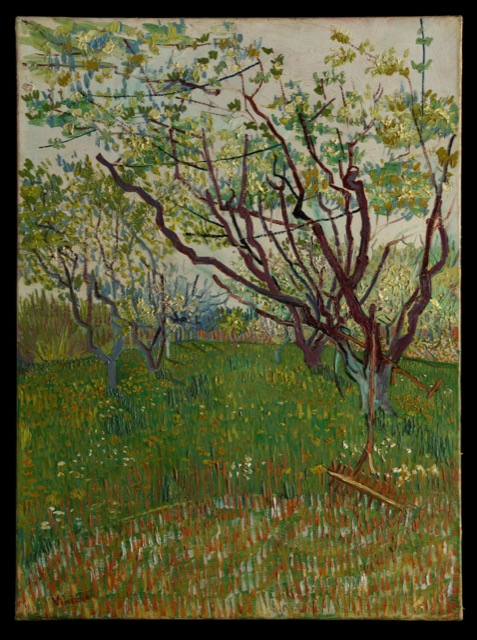
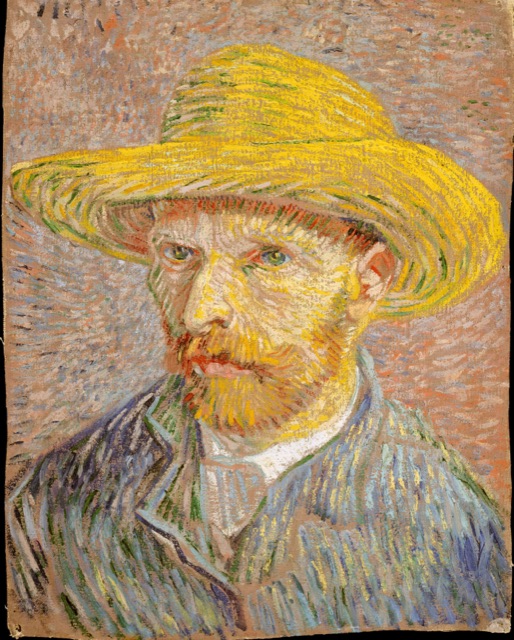
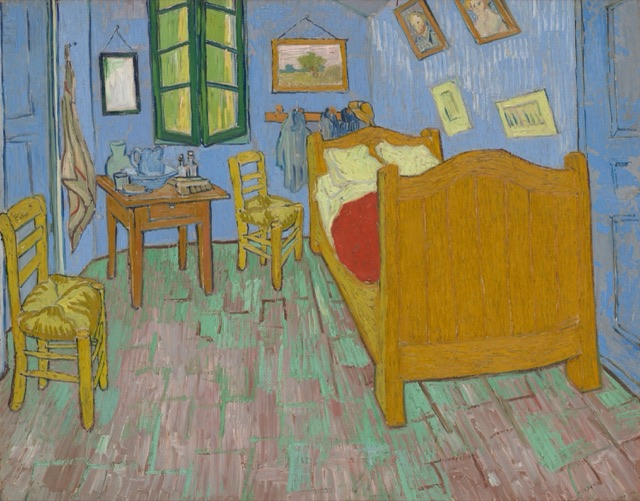
In 1886 he joined his brother Theo in Paris, where the work of Claude Monet and other modern painters brightened his colours. He answered the dotted technique of Georges Seurat with small, even strokes of his own, collected Japanese woodblock prints, and in 1887 painted copies after Hiroshige. In February 1888 he moved to Arles, in the south of France, and painted orchards in blossom, his bedroom and the Sunflowers.
After a crisis in which he cut off his ear, he spent a year in a hospital at Saint-Rémy and made about 150 paintings there. In May 1890 he moved to Auvers-sur-Oise. On 27 July he shot himself, and he died two days later, aged 37.