The Biglin Brothers Turning the Stake
Stop 1 · First look
First Look
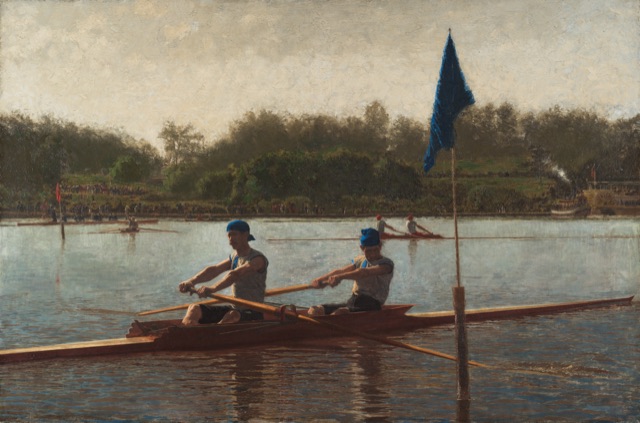
Look at the blue flag on its pole, standing in the water. It marks the halfway point of a race, and the two rowers are turning their boat around it. They are Barney and John Biglin, on the Schuylkill River in Philadelphia in May eighteen seventy-two. Thomas Eakins painted the moment a year later. Their rivals, in red, are well behind. The Biglins won.
Stop 2 · Technique
Closer Reading
Find the riverbank behind the rowers, and the steamboat on the right with smoke rising from it. The bank is lined with people, and the boat is crowded too. Rowing was among the most popular spectator sports in America in the eighteen seventies, and this was a famous race. Winning it made the Biglin brothers the most celebrated oarsmen of their time. Eakins had trained in the United States and in France, and he spent almost his whole career in Philadelphia, his home town. He built his compositions from painstaking drawings of the figures and of the perspective before he began to paint. The Cleveland Museum of Art calls his manner an unsentimental realism. Nothing here is prettied up. The water is flat, the light is ordinary afternoon light, and the two men are simply working. Look at their arms, and at the set of their backs. He signed the painting at the lower left, with his name and the year.
Stop 3 · Museum record
Catalog Summary
Barney and John Biglin swing their boat around the stake at the halfway point of a race on the Schuylkill River in Philadelphia in May 1872, with their rivals well behind. They won, and were the most celebrated oarsmen of their day. Eakins planned his pictures with careful perspective drawings. Oil on canvas, 101.3 × 151.4 cm.
Recorded physical scale: 151.4 × 101.3 cm (59.6 × 39.9 in · 1.51 × 1.01 m).
Stop 4 · Historical Context
Thomas Eakins (1844–1916)
Philadelphia painter of rowers, surgeons and sitters, known for exact, unsentimental pictures built from careful perspective drawings.
Realism (mid to late 19th century): Painting of the world as it looks, without making it grander or prettier: a movement that began in France in the 19th century, and a word used more widely for any style that keeps to appearances.
First Look
Look at the blue flag on its pole, standing in the water. It marks the halfway point of a race, and the two rowers are turning their boat around it. They are Barney and John Biglin, on the Schuylkill River in Philadelphia in May eighteen seventy-two. Thomas Eakins painted the moment a year later. Their rivals, in red, are well behind. The Biglins won.
Closer Reading
Find the riverbank behind the rowers, and the steamboat on the right with smoke rising from it. The bank is lined with people, and the boat is crowded too. Rowing was among the most popular spectator sports in America in the eighteen seventies, and this was a famous race. Winning it made the Biglin brothers the most celebrated oarsmen of their time. Eakins had trained in the United States and in France, and he spent almost his whole career in Philadelphia, his home town. He built his compositions from painstaking drawings of the figures and of the perspective before he began to paint. The Cleveland Museum of Art calls his manner an unsentimental realism. Nothing here is prettied up. The water is flat, the light is ordinary afternoon light, and the two men are simply working. Look at their arms, and at the set of their backs. He signed the painting at the lower left, with his name and the year.
Catalog Summary
Barney and John Biglin swing their boat around the stake at the halfway point of a race on the Schuylkill River in Philadelphia in May 1872, with their rivals well behind. They won, and were the most celebrated oarsmen of their day. Eakins planned his pictures with careful perspective drawings. Oil on canvas, 101.3 × 151.4 cm.
About the Artist
Thomas Eakins (1844–1916)
Thomas Eakins was born in Philadelphia in 1844 and spent almost his whole career there. He trained in the United States and in France, where he studied in Paris with the painter Jean-Léon Gérôme and others from 1866 to 1869. In 1870 he came home and began to paint the people and scenes he knew.
He wanted plain visual fact. He worked out each composition with painstaking figure and perspective drawings, and he painted oarsmen racing on the Schuylkill River with the same care as a portrait. His interest in science led to The Gross Clinic of 1875, which shows a famous surgeon at work in the operating theatre. Its frank showing of blood shocked people at the time.
Eakins also taught, and he put painting from the living nude model ahead of drawing from plaster casts. In 1886 the Pennsylvania Academy of the Fine Arts dismissed him for using nude models in classes that included women. After two years of depression he turned mainly to searching portraits, which he painted until his death in 1916.