1860–1909 · 3 works · The Cleveland Museum of Art
Three American Moments: Wilderness, River, Ring
Stop 1 of 3 · Frederic Edwin Church · 1860
Twilight in the Wilderness
First Look
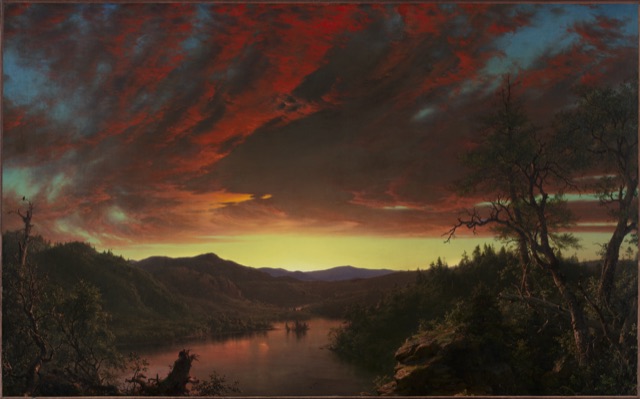
Look at the sky, where the clouds turn from red to violet and the horizon burns yellow. Frederic Edwin Church painted this sunset in eighteen sixty. The place is wild country near Mount Katahdin, in Maine, and there is no house, no boat and no person anywhere in it. He painted it in his studio in New York, from sketches made nearly two years before.
A closer look
Find the dead tree at the far left, with a single bird perched at its top. Then find the broken stump in the foreground below it. They are almost the only still things under that moving sky, and they are painted twig by twig and splinter by splinter. Church was a showman as well as a painter. The custom was to send a new picture to an annual exhibition, where it hung among the work of other artists. He showed this one by itself in a well-known gallery instead. Advance publicity and warm reviews did the rest, and several hundred people came to look at it during its seven weeks on view. The painting was finished on the eve of the Civil War. The Cleveland Museum of Art notes that its burning sky can be read as a sign of the conflagration that was coming. Now look at the water. It holds the whole sky again, darker and quieter.
A blazing sunset over wild country near Mount Katahdin in Maine, painted in Church’s New York studio from sketches made nearly two years earlier. He showed the picture by itself in a gallery, and hundreds came to see it. Finished on the eve of the Civil War, it has often been read as a sign of the coming conflict. Oil on canvas, 101.6 × 162.6 cm.
Stop 2 of 3 · Thomas Eakins · 1873
The Biglin Brothers Turning the Stake
First Look
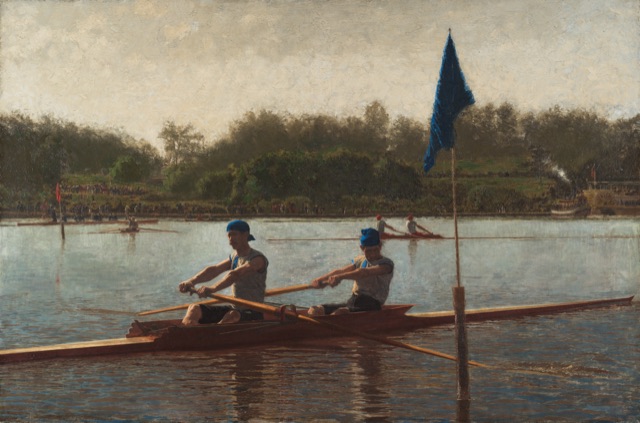
Look at the blue flag on its pole, standing in the water. It marks the halfway point of a race, and the two rowers are turning their boat around it. They are Barney and John Biglin, on the Schuylkill River in Philadelphia in May eighteen seventy-two. Thomas Eakins painted the moment a year later. Their rivals, in red, are well behind. The Biglins won.
A closer look
Find the riverbank behind the rowers, and the steamboat on the right with smoke rising from it. The bank is lined with people, and the boat is crowded too. Rowing was among the most popular spectator sports in America in the eighteen seventies, and this was a famous race. Winning it made the Biglin brothers the most celebrated oarsmen of their time. Eakins had trained in the United States and in France, and he spent almost his whole career in Philadelphia, his home town. He built his compositions from painstaking drawings of the figures and of the perspective before he began to paint. The Cleveland Museum of Art calls his manner an unsentimental realism. Nothing here is prettied up. The water is flat, the light is ordinary afternoon light, and the two men are simply working. Look at their arms, and at the set of their backs. He signed the painting at the lower left, with his name and the year.
Barney and John Biglin swing their boat around the stake at the halfway point of a race on the Schuylkill River in Philadelphia in May 1872, with their rivals well behind. They won, and were the most celebrated oarsmen of their day. Eakins planned his pictures with careful perspective drawings. Oil on canvas, 101.3 × 151.4 cm.
Stop 3 of 3 · George Bellows · 1909
Stag at Sharkey's
First Look
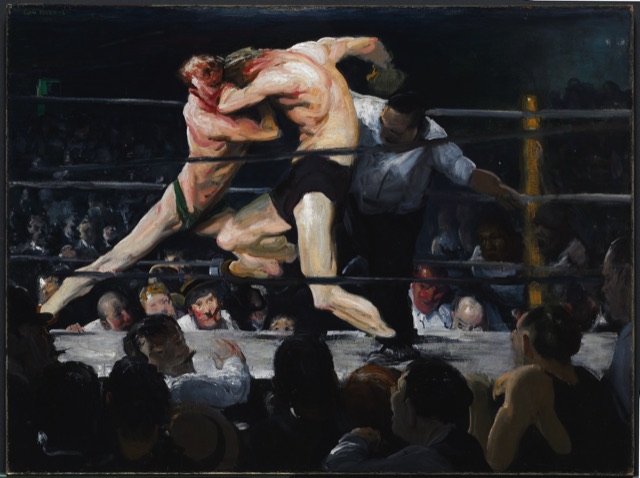
Look at the two fighters, and try to find where one body ends and the other begins. George Bellows painted them in nineteen oh nine with long, fast strokes, as if the paint itself had been thrown. This is Sharkey’s Athletic Club in New York, a saloon with a boxing ring in its back room. Around the ropes, the faces of the crowd look up out of the dark.
A closer look
Now look at the faces along the edge of the ring. Each is painted in a few strokes: flushed, grinning, shouting. Public boxing was against the law in New York at the time, so a bout had to be arranged as a private event for the members of a club. When an outsider fought, he was given a temporary membership and called a stag, which is where the painting gets its name. The club belonged to Tom Sharkey, a former fighter who had served in the navy, and it stood near Bellows’s studio. Boxing divided opinion. Some people thought it barbaric. Others, President Theodore Roosevelt among them, admired it as healthy and manly. Bellows takes no side. He puts us a few rows back, behind the dark heads of other spectators, and lets us watch. The referee leans in from the right. Nobody in the room is looking anywhere else.
Two boxers lock together under the lights of Sharkey’s Athletic Club, a New York saloon with a ring in its back room, near Bellows’s studio. Public boxing was illegal in the city, so bouts were held as private club events, and an outsider who fought was made a temporary member and called a stag. Oil on canvas, 92 × 122.6 cm.
1860Twilight in the Wilderness
A blazing sunset over wild country near Mount Katahdin in Maine, painted in Church’s New York studio from sketches made nearly two years earlier. He showed the picture by itself in a gallery, and hundreds came to see it. Finished on the eve of the Civil War, it has often been read as a sign of the coming conflict. Oil on canvas, 101.6 × 162.6 cm.
1873The Biglin Brothers Turning the Stake
Barney and John Biglin swing their boat around the stake at the halfway point of a race on the Schuylkill River in Philadelphia in May 1872, with their rivals well behind. They won, and were the most celebrated oarsmen of their day. Eakins planned his pictures with careful perspective drawings. Oil on canvas, 101.3 × 151.4 cm.
1909Stag at Sharkey's
Two boxers lock together under the lights of Sharkey’s Athletic Club, a New York saloon with a ring in its back room, near Bellows’s studio. Public boxing was illegal in the city, so bouts were held as private club events, and an outsider who fought was made a temporary member and called a stag. Oil on canvas, 92 × 122.6 cm.
Other exhibitions
The Sistine Chapel: Ceiling, Altar, and Wall Cycles
Michelangelo’s ceiling and Last Judgment alongside the fifteenth-century north and south wall narratives by Botticelli, Perugino, Ghirlandaio, Rosselli, and Signorelli.
1765–1857 · 7 worksEdo: Pictures of the Floating World
Seven woodblock prints from the city of Edo, 1765 to 1857: Harunobu, Kiyonaga, Sharaku, Utamaro and Hiroshige, from the Art Institute of Chicago.
1867–1893 · 7 worksImpressionism: Painters of Modern Life
Seven painters and seven views of modern France, 1867 to 1893: Monet, Renoir, Morisot, Caillebotte, Degas, Cassatt and Pissarro, from the Art Institute of Chicago.
1782–1893 · 6 worksFrom Edo to Paris: Ukiyo-e and the Impressionist Eye
How Japanese woodblock masters Hiroshige and Kiyonaga inspired the cropped framing, asymmetric diagonals, and rain-swept streets of Caillebotte, Degas, and Cassatt.