Twilight in the Wilderness
Stop 1 · First look
First Look
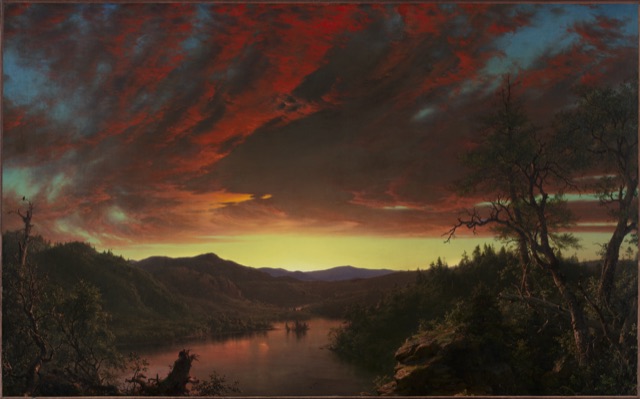
Look at the sky, where the clouds turn from red to violet and the horizon burns yellow. Frederic Edwin Church painted this sunset in eighteen sixty. The place is wild country near Mount Katahdin, in Maine, and there is no house, no boat and no person anywhere in it. He painted it in his studio in New York, from sketches made nearly two years before.
Stop 2 · Technique
Closer Reading
Find the dead tree at the far left, with a single bird perched at its top. Then find the broken stump in the foreground below it. They are almost the only still things under that moving sky, and they are painted twig by twig and splinter by splinter. Church was a showman as well as a painter. The custom was to send a new picture to an annual exhibition, where it hung among the work of other artists. He showed this one by itself in a well-known gallery instead. Advance publicity and warm reviews did the rest, and several hundred people came to look at it during its seven weeks on view. The painting was finished on the eve of the Civil War. The Cleveland Museum of Art notes that its burning sky can be read as a sign of the conflagration that was coming. Now look at the water. It holds the whole sky again, darker and quieter.
Stop 3 · Museum record
Catalog Summary
A blazing sunset over wild country near Mount Katahdin in Maine, painted in Church’s New York studio from sketches made nearly two years earlier. He showed the picture by itself in a gallery, and hundreds came to see it. Finished on the eve of the Civil War, it has often been read as a sign of the coming conflict. Oil on canvas, 101.6 × 162.6 cm.
Recorded physical scale: 162.6 × 101.6 cm (64.0 × 40.0 in · 1.63 × 1.02 m).
Stop 4 · Historical Context
Frederic Edwin Church (1826–1900)
Thomas Cole's pupil and a leader of the Hudson River School, who painted vast, exact landscapes from Niagara to the Andes.
Hudson River School (about 1825 to the 1870s): A loose group of American landscape painters, about 1825 to the 1870s, who painted the wilderness of the Hudson valley and beyond as vast, detailed and awe-inspiring.
First Look
Look at the sky, where the clouds turn from red to violet and the horizon burns yellow. Frederic Edwin Church painted this sunset in eighteen sixty. The place is wild country near Mount Katahdin, in Maine, and there is no house, no boat and no person anywhere in it. He painted it in his studio in New York, from sketches made nearly two years before.
Closer Reading
Find the dead tree at the far left, with a single bird perched at its top. Then find the broken stump in the foreground below it. They are almost the only still things under that moving sky, and they are painted twig by twig and splinter by splinter. Church was a showman as well as a painter. The custom was to send a new picture to an annual exhibition, where it hung among the work of other artists. He showed this one by itself in a well-known gallery instead. Advance publicity and warm reviews did the rest, and several hundred people came to look at it during its seven weeks on view. The painting was finished on the eve of the Civil War. The Cleveland Museum of Art notes that its burning sky can be read as a sign of the conflagration that was coming. Now look at the water. It holds the whole sky again, darker and quieter.
Catalog Summary
A blazing sunset over wild country near Mount Katahdin in Maine, painted in Church’s New York studio from sketches made nearly two years earlier. He showed the picture by itself in a gallery, and hundreds came to see it. Finished on the eve of the Civil War, it has often been read as a sign of the coming conflict. Oil on canvas, 101.6 × 162.6 cm.
About the Artist
Frederic Edwin Church (1826–1900)
Frederic Edwin Church was born in Hartford, Connecticut, in 1826, the son of a silversmith. From 1844 to 1846 he studied with Thomas Cole in Catskill, New York. In 1847 he moved to New York City.
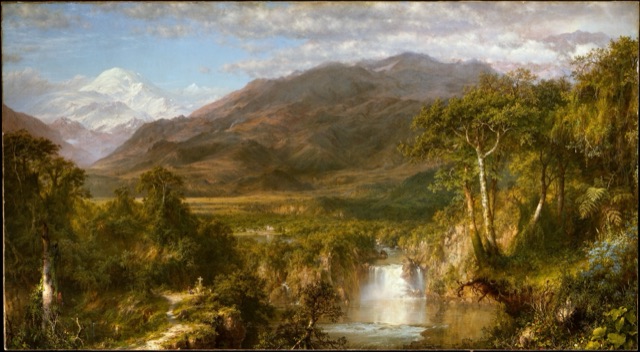
Inspired by the German naturalist Alexander von Humboldt, he went to South America in 1853 and 1857, and to Labrador to see icebergs. He sketched on the spot, then combined many sketches into one huge studio picture, accurate in every plant and rock. In 1859 he showed Heart of the Andes by itself, at 25 cents a visit. It sold for 10,000 dollars, then the highest price paid to a living American artist.
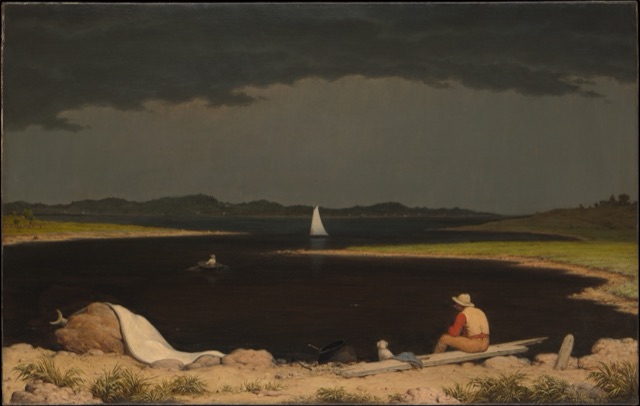
He travelled to Maine with his friend Sanford Robinson Gifford, and for a time shared a studio in the Tenth Street Studio Building with Martin Johnson Heade. In 1860 he married Isabel Carnes and bought a farm near Hudson, New York, across the river from Cole's old home. There he built Olana, a Persian-inspired house. Rheumatism later made painting hard. He died in New York in 1900.