Approaching Thunder Storm
Stop 1 · First look
First Look
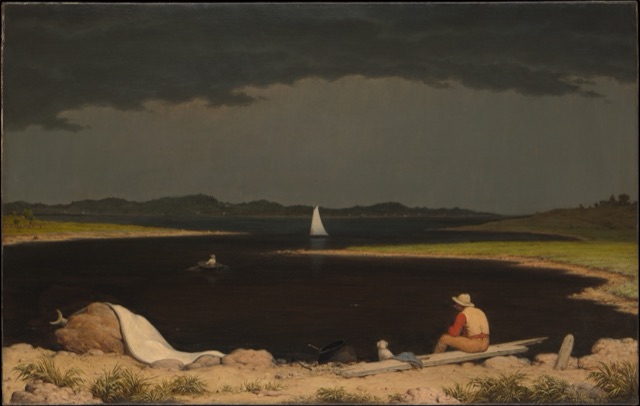
Look at the water. It has gone almost black, as it does in the minutes before a storm, and the far shore is still lit a strange bright green. One white sail is heading in. On the beach a man in a red shirt sits on a plank with his dog beside him, simply watching. Martin Johnson Heade painted this in eighteen fifty-nine, from a storm he had seen on the Rhode Island coast.
Stop 2 · Technique
Closer Reading
Notice how still everything is. Nothing in the picture is moving except, perhaps, the rower far out on the water, pulling for shore. Heade has chosen the moment before the weather arrives, when the light turns hard and every shape has a sharp edge: the curve of the beach, the sail, the cloth spread over the rock. Most landscape painters of his generation went looking for mountains and waterfalls. Heade preferred flat places, salt marshes and shorelines, and what interested him there was the light and the air at a particular hour. This is the earliest of his thunderstorm pictures and still the best known. It was painted in eighteen fifty-nine, and some viewers have felt in its tension the mood of a country two years from civil war. Heade left no comment on that.
Stop 3 · Museum record
Catalog Summary
Black water, a darkening sky and one white sail: a storm is about to break over a small bay on the New England coast. A man in a red shirt sits with his dog and watches it come. Oil on canvas, 71.1 × 111.8 cm.
Recorded physical scale: 111.8 × 71.1 cm (44.0 × 28.0 in · 1.12 × 0.71 m).
Stop 4 · Historical Context
Martin Johnson Heade (1819–1904)
American painter of salt marshes, coming storms, hummingbirds and orchids, a friend of Frederic Church who kept apart from the New York art world.
Hudson River School (about 1825 to the 1870s): A loose group of American landscape painters, about 1825 to the 1870s, who painted the wilderness of the Hudson valley and beyond as vast, detailed and awe-inspiring.
First Look
Look at the water. It has gone almost black, as it does in the minutes before a storm, and the far shore is still lit a strange bright green. One white sail is heading in. On the beach a man in a red shirt sits on a plank with his dog beside him, simply watching. Martin Johnson Heade painted this in eighteen fifty-nine, from a storm he had seen on the Rhode Island coast.
Closer Reading
Notice how still everything is. Nothing in the picture is moving except, perhaps, the rower far out on the water, pulling for shore. Heade has chosen the moment before the weather arrives, when the light turns hard and every shape has a sharp edge: the curve of the beach, the sail, the cloth spread over the rock. Most landscape painters of his generation went looking for mountains and waterfalls. Heade preferred flat places, salt marshes and shorelines, and what interested him there was the light and the air at a particular hour. This is the earliest of his thunderstorm pictures and still the best known. It was painted in eighteen fifty-nine, and some viewers have felt in its tension the mood of a country two years from civil war. Heade left no comment on that.
Catalog Summary
Black water, a darkening sky and one white sail: a storm is about to break over a small bay on the New England coast. A man in a red shirt sits with his dog and watches it come. Oil on canvas, 71.1 × 111.8 cm.
About the Artist
Martin Johnson Heade (1819–1904)
Martin Johnson Heade was born in Lumberville, Pennsylvania, in 1819. He studied with Edward Hicks and Thomas Hicks and began by painting portraits. After three years in Europe he kept moving, living in Philadelphia, New York, Saint Louis, Chicago, Trenton and Providence between 1840 and 1859.
About 1859 he settled in New York and turned to landscape. There he met Frederic Edwin Church, a lifelong friend, and for a time the two shared a studio in the Tenth Street Studio Building. Heade painted salt marshes many times, studying the changing weather and light. His precise, light-filled manner was later named Luminism. He kept apart from the New York art world. Scholars debate whether he belongs to the Hudson River School, because he painted relatively few landscapes.
Between 1860 and 1870 he travelled three times to Central and South America, perhaps encouraged by Church. These journeys gave him his most original pictures: hummingbirds and orchids in tropical settings. In 1883, aged sixty-four, he married and moved to St. Augustine, Florida. He died there in 1904, forgotten by the art world.