1836–1863 · 5 works · The Metropolitan Museum of Art
The American Sublime: Hudson River School
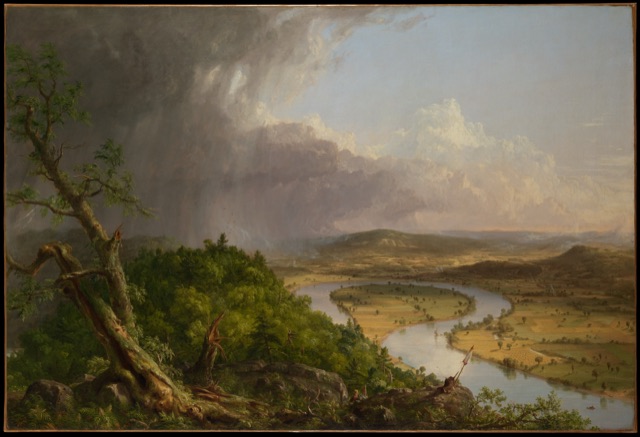
Stop 1 of 5 · Thomas Cole · 1836
View from Mount Holyoke, Northampton, Massachusetts, after a Thunderstorm—The Oxbow
First Look
Look at the rocks in the lower centre of the canvas, just left of the furled umbrella. A small figure in a hat is sitting there at an easel, turned to look back at us. That is the painter, Thomas Cole. He made this view of the Connecticut River in eighteen thirty-six. On the left the storm is leaving over wild forest. On the right the sun is already on the fields.
A closer look
Step back and let the picture divide in two. A diagonal runs from the shattered tree at the lower left to the far hills. Above and left of it are storm cloud and untouched forest. Below and right are fields, boats on the river and threads of smoke from farmhouses. Cole was born in England and came to America as a young man, and he became the first great painter of its scenery. He admired the wild country and worried about how quickly it was being cleared. This canvas, shown in New York in eighteen thirty-six, holds both feelings in a single view, and he does not say which side he is on. The loop of the river gave the painting its familiar name, The Oxbow. Follow its curve once more. Some people see a question mark drawn on the valley floor.
From a hilltop in Massachusetts, a storm moves off to the left over broken forest while sunlight returns to the farmland in the loop of the Connecticut River. Cole painted himself into the foreground, at work. Oil on canvas, 130.8 × 193 cm.
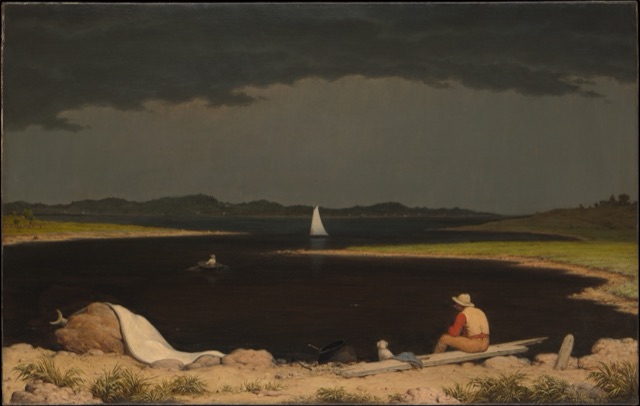
Stop 2 of 5 · Martin Johnson Heade · 1859
Approaching Thunder Storm
First Look
Look at the water. It has gone almost black, as it does in the minutes before a storm, and the far shore is still lit a strange bright green. One white sail is heading in. On the beach a man in a red shirt sits on a plank with his dog beside him, simply watching. Martin Johnson Heade painted this in eighteen fifty-nine, from a storm he had seen on the Rhode Island coast.
A closer look
Notice how still everything is. Nothing in the picture is moving except, perhaps, the rower far out on the water, pulling for shore. Heade has chosen the moment before the weather arrives, when the light turns hard and every shape has a sharp edge: the curve of the beach, the sail, the cloth spread over the rock. Most landscape painters of his generation went looking for mountains and waterfalls. Heade preferred flat places, salt marshes and shorelines, and what interested him there was the light and the air at a particular hour. This is the earliest of his thunderstorm pictures and still the best known. It was painted in eighteen fifty-nine, and some viewers have felt in its tension the mood of a country two years from civil war. Heade left no comment on that.
Black water, a darkening sky and one white sail: a storm is about to break over a small bay on the New England coast. A man in a red shirt sits with his dog and watches it come. Oil on canvas, 71.1 × 111.8 cm.
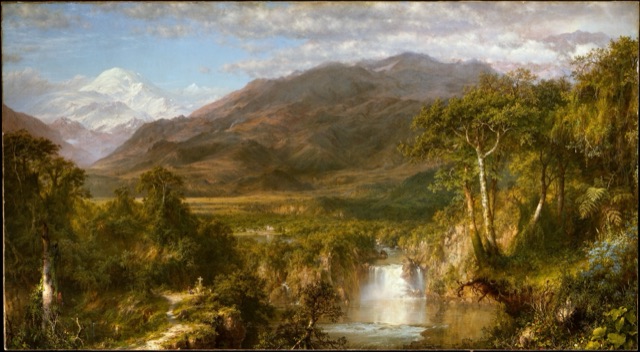
Stop 3 of 5 · Frederic Edwin Church · 1859
Heart of the Andes
First Look
Look at the sunlit tree trunk at the lower left. Frederic Church cut his name and the year into its bark, in paint. Then let your eyes travel: along the path to a white cross where two people have stopped, across the pool and the waterfall, and up to the snow peak in the far distance. Church painted this in eighteen fifty-nine from sketches made in Ecuador. No single place looks like this.
A closer look
Come close and pick any patch of the foreground: ferns, vines, butterflies, birds in the branches. Each plant is painted exactly enough for a botanist to name it. Church had travelled to South America twice in the eighteen fifties, following the route of the German naturalist Alexander von Humboldt, who believed that the tropics showed the whole order of nature in one landscape, from jungle floor to ice. The painting was Church’s answer. In the spring of eighteen fifty-nine he showed it by itself in a darkened room in New York, in a frame built to look like a window, and twelve thousand people paid twenty-five cents each to see it. Many brought opera glasses and explored it piece by piece, as you can here. It sold for ten thousand dollars, then the highest price paid for a work by a living American artist.
A composite of the mountains, forests and rivers Church had sketched in Ecuador, painted three metres wide in his New York studio. In 1859 crowds paid to see it shown alone, and studied it through opera glasses. Oil on canvas, 168 × 302.9 cm.
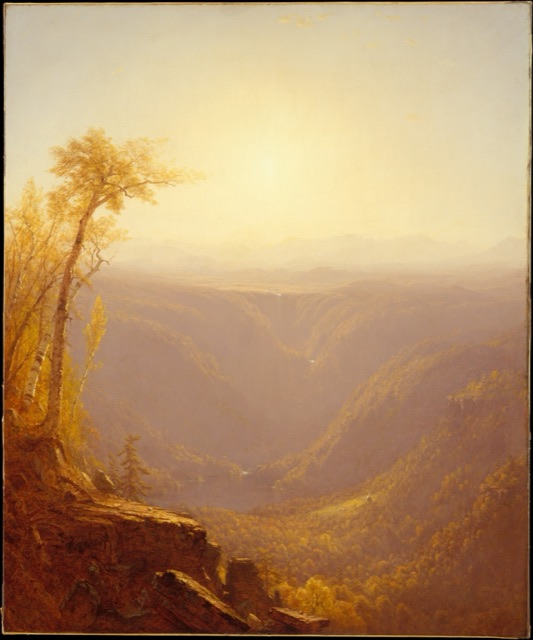
Stop 4 of 5 · Sanford Robinson Gifford · 1862
A Gorge in the Mountains (Kauterskill Clove)
First Look
Look straight into the brightest part of the picture, where the sun sits just above the far ridge. Almost nothing there has an edge. Sanford Gifford has painted the air itself, thick with gold light, and let the valley sink into it. This is Kaaterskill Clove in the Catskill Mountains of New York, in eighteen sixty-two. On the ledge at the lower left, nearly lost in the red rock, a hunter and his dog are climbing up into the view.
A closer look
Find the small pale glint far down the valley, almost lost in the haze. It is water, at the head of the gorge. A few miles from here Thomas Cole had made his first sketches of the Catskills nearly forty years earlier, and by Gifford’s time the clove was among the best known pieces of wild scenery in America. Gifford had grown up nearby and painted it again and again. He was less interested in rocks and trees than in what light does to distance, and he finished his pictures with thin warm glazes that bind everything into one tone. The date matters too. In eighteen sixty-two the Civil War was in its second year, and Gifford was serving with a New York regiment between painting seasons. This is a view of home, made in wartime, and it is entirely at peace.
The whole valley of Kaaterskill Clove in the Catskill Mountains dissolves in late sun. Gifford’s real subject is the lit haze itself; landscape painting, he said, is air painting. Oil on canvas, 121.9 × 101.3 cm.
Stop 5 of 5 · Albert Bierstadt · 1863
The Rocky Mountains, Lander's Peak
First Look
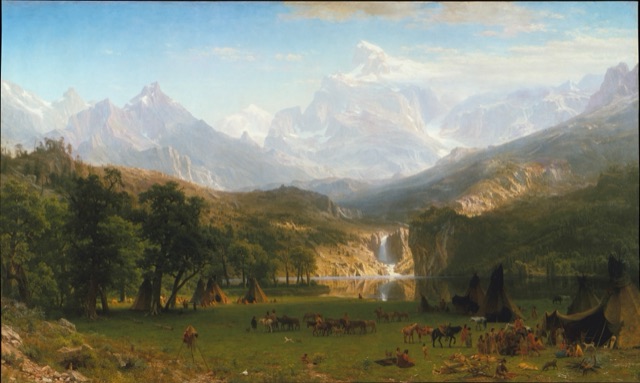
Look at the bright patch in the middle distance, where a waterfall drops into a lake and the light breaks through. Everything in this enormous picture is arranged to lead you there, and then up to the white summit above. Albert Bierstadt painted it in eighteen sixty-three. He had travelled to the Rocky Mountains four years earlier with a survey expedition. In the foreground is a camp of Shoshone people, with their horses and lodges.
A closer look
Walk your eyes along the foreground from left to right. There are riders coming in, dogs, people cooking and talking, a hide stretched on poles, and Bierstadt painted these groups from studies he made on the spot. The mountains behind them are another matter. He raised and sharpened the peaks until they look more like the Alps of his native Germany than the Wind River Range. He named the highest for Frederick Lander, the leader of the expedition, who had died the year before while serving in the Civil War. Shown in New York in eighteen sixty-four, across the room from Church’s Heart of the Andes, the painting made Bierstadt famous and sold for twenty-five thousand dollars. For visitors in the East it was a first sight of the West, grand and apparently untouched. The railroads and settlers who followed would change the lives of the people in this camp within a generation.
A Shoshone camp fills a sunlit meadow below a waterfall and a wall of snow peaks in what is now Wyoming. Bierstadt built the scene in New York from sketches made with a government survey party in 1859. Oil on canvas, 186.7 × 306.7 cm.
1836View from Mount Holyoke, Northampton, Massachusetts, after a…
From a hilltop in Massachusetts, a storm moves off to the left over broken forest while sunlight returns to the farmland in the loop of the Connecticut River. Cole painted himself into the foreground, at work. Oil on canvas, 130.8 × 193 cm.
1859Approaching Thunder Storm
Black water, a darkening sky and one white sail: a storm is about to break over a small bay on the New England coast. A man in a red shirt sits with his dog and watches it come. Oil on canvas, 71.1 × 111.8 cm.
1859Heart of the Andes
A composite of the mountains, forests and rivers Church had sketched in Ecuador, painted three metres wide in his New York studio. In 1859 crowds paid to see it shown alone, and studied it through opera glasses. Oil on canvas, 168 × 302.9 cm.
1862A Gorge in the Mountains (Kauterskill Clove)
The whole valley of Kaaterskill Clove in the Catskill Mountains dissolves in late sun. Gifford’s real subject is the lit haze itself; landscape painting, he said, is air painting. Oil on canvas, 121.9 × 101.3 cm.
1863The Rocky Mountains, Lander's Peak
A Shoshone camp fills a sunlit meadow below a waterfall and a wall of snow peaks in what is now Wyoming. Bierstadt built the scene in New York from sketches made with a government survey party in 1859. Oil on canvas, 186.7 × 306.7 cm.
Other exhibitions
The Sistine Chapel: Ceiling, Altar, and Wall Cycles
Michelangelo’s ceiling and Last Judgment alongside the fifteenth-century north and south wall narratives by Botticelli, Perugino, Ghirlandaio, Rosselli, and Signorelli.
1765–1857 · 7 worksEdo: Pictures of the Floating World
Seven woodblock prints from the city of Edo, 1765 to 1857: Harunobu, Kiyonaga, Sharaku, Utamaro and Hiroshige, from the Art Institute of Chicago.
1867–1893 · 7 worksImpressionism: Painters of Modern Life
Seven painters and seven views of modern France, 1867 to 1893: Monet, Renoir, Morisot, Caillebotte, Degas, Cassatt and Pissarro, from the Art Institute of Chicago.
1782–1893 · 6 worksFrom Edo to Paris: Ukiyo-e and the Impressionist Eye
How Japanese woodblock masters Hiroshige and Kiyonaga inspired the cropped framing, asymmetric diagonals, and rain-swept streets of Caillebotte, Degas, and Cassatt.