View from Mount Holyoke, Northampton, Massachusetts, after a Thunderstorm—The Oxbow
Stop 1 · First look
First Look
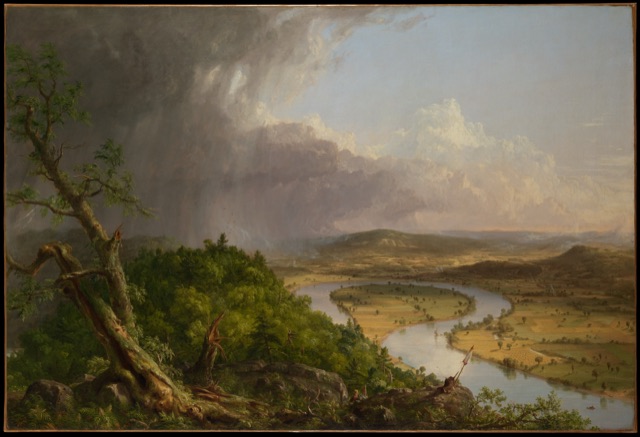
Look at the rocks in the lower centre of the canvas, just left of the furled umbrella. A small figure in a hat is sitting there at an easel, turned to look back at us. That is the painter, Thomas Cole. He made this view of the Connecticut River in eighteen thirty-six. On the left the storm is leaving over wild forest. On the right the sun is already on the fields.
Stop 2 · Technique
Closer Reading
Step back and let the picture divide in two. A diagonal runs from the shattered tree at the lower left to the far hills. Above and left of it are storm cloud and untouched forest. Below and right are fields, boats on the river and threads of smoke from farmhouses. Cole was born in England and came to America as a young man, and he became the first great painter of its scenery. He admired the wild country and worried about how quickly it was being cleared. This canvas, shown in New York in eighteen thirty-six, holds both feelings in a single view, and he does not say which side he is on. The loop of the river gave the painting its familiar name, The Oxbow. Follow its curve once more. Some people see a question mark drawn on the valley floor.
Stop 3 · Museum record
Catalog Summary
From a hilltop in Massachusetts, a storm moves off to the left over broken forest while sunlight returns to the farmland in the loop of the Connecticut River. Cole painted himself into the foreground, at work. Oil on canvas, 130.8 × 193 cm.
Recorded physical scale: 193.0 × 130.8 cm (76.0 × 51.5 in · 1.93 × 1.31 m).
Stop 4 · Historical Context
Thomas Cole (1801–1848)
English-born painter whose views of the Catskills and the Hudson valley began the Hudson River School of American landscape painting.
Hudson River School (about 1825 to the 1870s): A loose group of American landscape painters, about 1825 to the 1870s, who painted the wilderness of the Hudson valley and beyond as vast, detailed and awe-inspiring.
First Look
Look at the rocks in the lower centre of the canvas, just left of the furled umbrella. A small figure in a hat is sitting there at an easel, turned to look back at us. That is the painter, Thomas Cole. He made this view of the Connecticut River in eighteen thirty-six. On the left the storm is leaving over wild forest. On the right the sun is already on the fields.
Closer Reading
Step back and let the picture divide in two. A diagonal runs from the shattered tree at the lower left to the far hills. Above and left of it are storm cloud and untouched forest. Below and right are fields, boats on the river and threads of smoke from farmhouses. Cole was born in England and came to America as a young man, and he became the first great painter of its scenery. He admired the wild country and worried about how quickly it was being cleared. This canvas, shown in New York in eighteen thirty-six, holds both feelings in a single view, and he does not say which side he is on. The loop of the river gave the painting its familiar name, The Oxbow. Follow its curve once more. Some people see a question mark drawn on the valley floor.
Catalog Summary
From a hilltop in Massachusetts, a storm moves off to the left over broken forest while sunlight returns to the farmland in the loop of the Connecticut River. Cole painted himself into the foreground, at work. Oil on canvas, 130.8 × 193 cm.
About the Artist
Thomas Cole (1801–1848)
Thomas Cole was born in 1801 in Bolton, Lancashire, England. His family emigrated to the United States in 1818, and he worked as an engraver and a travelling portrait painter. In 1825 he moved to New York and went sketching up the Hudson River into the Catskill Mountains. The landscapes that followed were noticed by New York artists, among them Asher B. Durand, a lifelong friend.
Cole sketched trees, rocks and waterfalls outdoors and worked them into pictures composed in the studio. He painted the American wilderness with a poet's feeling for its space and grandeur. He painted series with moral and religious themes, among them The Course of Empire and The Voyage of Life. From 1829 to 1832 he travelled in England, France and Italy.
In 1836 he married Maria Bartow and settled at Cedar Grove, her family's house in Catskill, New York. He spoke out against the railways and industry changing the Catskills. From 1844 to 1846 Frederic Edwin Church was his pupil. Cole died at Cedar Grove in February 1848.