The Rocky Mountains, Lander's Peak
Stop 1 · First look
First Look
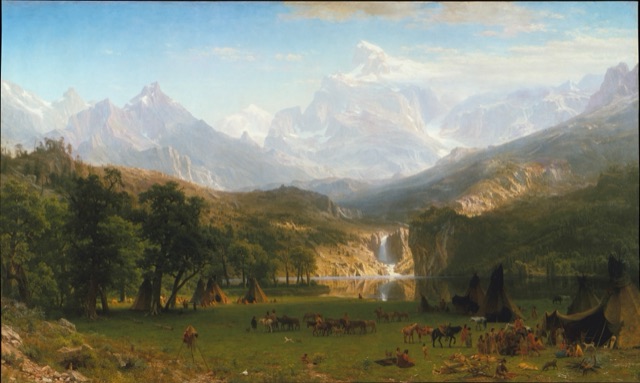
Look at the bright patch in the middle distance, where a waterfall drops into a lake and the light breaks through. Everything in this enormous picture is arranged to lead you there, and then up to the white summit above. Albert Bierstadt painted it in eighteen sixty-three. He had travelled to the Rocky Mountains four years earlier with a survey expedition. In the foreground is a camp of Shoshone people, with their horses and lodges.
Stop 2 · Technique
Closer Reading
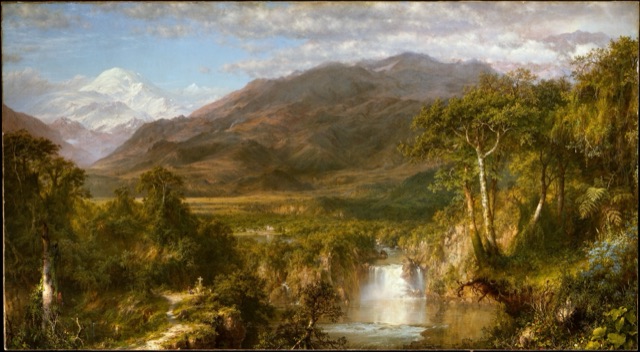
Walk your eyes along the foreground from left to right. There are riders coming in, dogs, people cooking and talking, a hide stretched on poles, and Bierstadt painted these groups from studies he made on the spot. The mountains behind them are another matter. He raised and sharpened the peaks until they look more like the Alps of his native Germany than the Wind River Range. He named the highest for Frederick Lander, the leader of the expedition, who had died the year before while serving in the Civil War. Shown in New York in eighteen sixty-four, across the room from Church’s Heart of the Andes, the painting made Bierstadt famous and sold for twenty-five thousand dollars. For visitors in the East it was a first sight of the West, grand and apparently untouched. The railroads and settlers who followed would change the lives of the people in this camp within a generation.
Stop 3 · Museum record
Catalog Summary
A Shoshone camp fills a sunlit meadow below a waterfall and a wall of snow peaks in what is now Wyoming. Bierstadt built the scene in New York from sketches made with a government survey party in 1859. Oil on canvas, 186.7 × 306.7 cm.
Recorded physical scale: 306.7 × 186.7 cm (120.7 × 73.5 in · 3.07 × 1.87 m).
Stop 4 · Historical Context
Albert Bierstadt (1830–1902)
German-born American painter whose huge canvases of the Rocky Mountains and Yosemite made him a leading painter of the American West.
Hudson River School (about 1825 to the 1870s): A loose group of American landscape painters, about 1825 to the 1870s, who painted the wilderness of the Hudson valley and beyond as vast, detailed and awe-inspiring.
First Look
Look at the bright patch in the middle distance, where a waterfall drops into a lake and the light breaks through. Everything in this enormous picture is arranged to lead you there, and then up to the white summit above. Albert Bierstadt painted it in eighteen sixty-three. He had travelled to the Rocky Mountains four years earlier with a survey expedition. In the foreground is a camp of Shoshone people, with their horses and lodges.
Closer Reading
Walk your eyes along the foreground from left to right. There are riders coming in, dogs, people cooking and talking, a hide stretched on poles, and Bierstadt painted these groups from studies he made on the spot. The mountains behind them are another matter. He raised and sharpened the peaks until they look more like the Alps of his native Germany than the Wind River Range. He named the highest for Frederick Lander, the leader of the expedition, who had died the year before while serving in the Civil War. Shown in New York in eighteen sixty-four, across the room from Church’s Heart of the Andes, the painting made Bierstadt famous and sold for twenty-five thousand dollars. For visitors in the East it was a first sight of the West, grand and apparently untouched. The railroads and settlers who followed would change the lives of the people in this camp within a generation.
Catalog Summary
A Shoshone camp fills a sunlit meadow below a waterfall and a wall of snow peaks in what is now Wyoming. Bierstadt built the scene in New York from sketches made with a government survey party in 1859. Oil on canvas, 186.7 × 306.7 cm.
About the Artist
Albert Bierstadt (1830–1902)
Albert Bierstadt was born in Solingen, Germany, in 1830. He was two when his family settled in New Bedford, Massachusetts. Self-taught at first, he went back to Germany in 1853 to study in Düsseldorf, where he met the American painters Emanuel Leutze and Worthington Whittredge. He sketched in Germany, Switzerland and Italy and came home in 1857.
In 1859 he went west with an expedition led by Colonel Frederick W. Lander. He sketched the Rocky Mountains and took stereoscopic photographs, pairs of pictures that look three-dimensional in a viewer. From such sketches he painted very large canvases. The Rocky Mountains, Lander's Peak (1863), more than three metres wide, made the public rank him with Frederic Edwin Church. It was shown opposite Church's Heart of the Andes at the New York Sanitary Fair.
A second journey in 1863, with the writer Fitz Hugh Ludlow, took him to the Pacific coast, the Yosemite Valley and Oregon. In 1867 he exhibited in London. His fame faded as Impressionism gained ground in America, and he died in New York in 1902.