A Gorge in the Mountains (Kauterskill Clove)
Stop 1 · First look
First Look
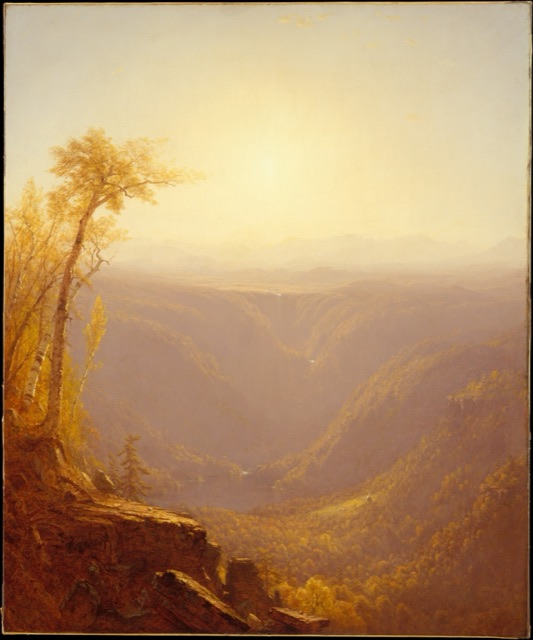
Look straight into the brightest part of the picture, where the sun sits just above the far ridge. Almost nothing there has an edge. Sanford Gifford has painted the air itself, thick with gold light, and let the valley sink into it. This is Kaaterskill Clove in the Catskill Mountains of New York, in eighteen sixty-two. On the ledge at the lower left, nearly lost in the red rock, a hunter and his dog are climbing up into the view.
Stop 2 · Technique
Closer Reading
Find the small pale glint far down the valley, almost lost in the haze. It is water, at the head of the gorge. A few miles from here Thomas Cole had made his first sketches of the Catskills nearly forty years earlier, and by Gifford’s time the clove was among the best known pieces of wild scenery in America. Gifford had grown up nearby and painted it again and again. He was less interested in rocks and trees than in what light does to distance, and he finished his pictures with thin warm glazes that bind everything into one tone. The date matters too. In eighteen sixty-two the Civil War was in its second year, and Gifford was serving with a New York regiment between painting seasons. This is a view of home, made in wartime, and it is entirely at peace.
Stop 3 · Museum record
Catalog Summary
The whole valley of Kaaterskill Clove in the Catskill Mountains dissolves in late sun. Gifford’s real subject is the lit haze itself; landscape painting, he said, is air painting. Oil on canvas, 121.9 × 101.3 cm.
Recorded physical scale: 101.3 × 121.9 cm (39.9 × 48.0 in · 1.01 × 1.22 m).
Stop 4 · Historical Context
Sanford Robinson Gifford (1823–1880)
Hudson River School painter from the Hudson valley, known for large views of wild scenery filled with soft, golden light.
Hudson River School (about 1825 to the 1870s): A loose group of American landscape painters, about 1825 to the 1870s, who painted the wilderness of the Hudson valley and beyond as vast, detailed and awe-inspiring.
First Look
Look straight into the brightest part of the picture, where the sun sits just above the far ridge. Almost nothing there has an edge. Sanford Gifford has painted the air itself, thick with gold light, and let the valley sink into it. This is Kaaterskill Clove in the Catskill Mountains of New York, in eighteen sixty-two. On the ledge at the lower left, nearly lost in the red rock, a hunter and his dog are climbing up into the view.
Closer Reading
Find the small pale glint far down the valley, almost lost in the haze. It is water, at the head of the gorge. A few miles from here Thomas Cole had made his first sketches of the Catskills nearly forty years earlier, and by Gifford’s time the clove was among the best known pieces of wild scenery in America. Gifford had grown up nearby and painted it again and again. He was less interested in rocks and trees than in what light does to distance, and he finished his pictures with thin warm glazes that bind everything into one tone. The date matters too. In eighteen sixty-two the Civil War was in its second year, and Gifford was serving with a New York regiment between painting seasons. This is a view of home, made in wartime, and it is entirely at peace.
Catalog Summary
The whole valley of Kaaterskill Clove in the Catskill Mountains dissolves in late sun. Gifford’s real subject is the lit haze itself; landscape painting, he said, is air painting. Oil on canvas, 121.9 × 101.3 cm.
About the Artist
Sanford Robinson Gifford (1823–1880)
Sanford Robinson Gifford was born in Greenfield, New York, in 1823 and grew up in Hudson, New York, the son of a prosperous foundry owner. After two years at Brown University he moved to New York City in 1845 to study drawing with John Rubens Smith. A sketching trip to the Catskill Mountains in 1846 turned him to landscape.
From 1855 to 1857 he travelled through Europe, at times with Albert Bierstadt and Worthington Whittredge. Back home he spent his summers sketching and fishing in New England and upstate New York. He became a friend of Frederic Edwin Church, and the two travelled together to Mount Katahdin in Maine. Gifford is known for large pictures of wild scenery filled with soft, glowing, golden light.
During the Civil War he served in the Seventh New York Regiment. In 1868 and 1869 he visited Italy, Egypt, Greece and the Near East, and in 1870 the Rocky Mountains of Colorado. He died in New York City in 1880, and the Metropolitan Museum of Art held a memorial exhibition of his paintings.