Heart of the Andes
Stop 1 · First look
First Look
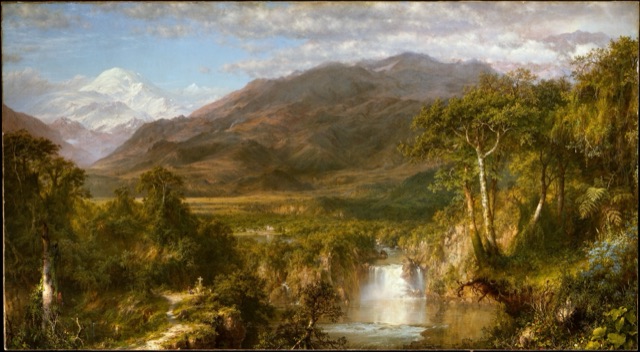
Look at the sunlit tree trunk at the lower left. Frederic Church cut his name and the year into its bark, in paint. Then let your eyes travel: along the path to a white cross where two people have stopped, across the pool and the waterfall, and up to the snow peak in the far distance. Church painted this in eighteen fifty-nine from sketches made in Ecuador. No single place looks like this.
Stop 2 · Technique
Closer Reading
Come close and pick any patch of the foreground: ferns, vines, butterflies, birds in the branches. Each plant is painted exactly enough for a botanist to name it. Church had travelled to South America twice in the eighteen fifties, following the route of the German naturalist Alexander von Humboldt, who believed that the tropics showed the whole order of nature in one landscape, from jungle floor to ice. The painting was Church’s answer. In the spring of eighteen fifty-nine he showed it by itself in a darkened room in New York, in a frame built to look like a window, and twelve thousand people paid twenty-five cents each to see it. Many brought opera glasses and explored it piece by piece, as you can here. It sold for ten thousand dollars, then the highest price paid for a work by a living American artist.
Stop 3 · Museum record
Catalog Summary
A composite of the mountains, forests and rivers Church had sketched in Ecuador, painted three metres wide in his New York studio. In 1859 crowds paid to see it shown alone, and studied it through opera glasses. Oil on canvas, 168 × 302.9 cm.
Recorded physical scale: 305.3 × 168.0 cm (120.2 × 66.1 in · 3.05 × 1.68 m).
Stop 4 · Historical Context
Frederic Edwin Church (1826–1900)
Thomas Cole's pupil and a leader of the Hudson River School, who painted vast, exact landscapes from Niagara to the Andes.
Hudson River School (about 1825 to the 1870s): A loose group of American landscape painters, about 1825 to the 1870s, who painted the wilderness of the Hudson valley and beyond as vast, detailed and awe-inspiring.
First Look
Look at the sunlit tree trunk at the lower left. Frederic Church cut his name and the year into its bark, in paint. Then let your eyes travel: along the path to a white cross where two people have stopped, across the pool and the waterfall, and up to the snow peak in the far distance. Church painted this in eighteen fifty-nine from sketches made in Ecuador. No single place looks like this.
Closer Reading
Come close and pick any patch of the foreground: ferns, vines, butterflies, birds in the branches. Each plant is painted exactly enough for a botanist to name it. Church had travelled to South America twice in the eighteen fifties, following the route of the German naturalist Alexander von Humboldt, who believed that the tropics showed the whole order of nature in one landscape, from jungle floor to ice. The painting was Church’s answer. In the spring of eighteen fifty-nine he showed it by itself in a darkened room in New York, in a frame built to look like a window, and twelve thousand people paid twenty-five cents each to see it. Many brought opera glasses and explored it piece by piece, as you can here. It sold for ten thousand dollars, then the highest price paid for a work by a living American artist.
Catalog Summary
A composite of the mountains, forests and rivers Church had sketched in Ecuador, painted three metres wide in his New York studio. In 1859 crowds paid to see it shown alone, and studied it through opera glasses. Oil on canvas, 168 × 302.9 cm.
About the Artist
Frederic Edwin Church (1826–1900)
Frederic Edwin Church was born in Hartford, Connecticut, in 1826, the son of a silversmith. From 1844 to 1846 he studied with Thomas Cole in Catskill, New York. In 1847 he moved to New York City.
Inspired by the German naturalist Alexander von Humboldt, he went to South America in 1853 and 1857, and to Labrador to see icebergs. He sketched on the spot, then combined many sketches into one huge studio picture, accurate in every plant and rock. In 1859 he showed Heart of the Andes by itself, at 25 cents a visit. It sold for 10,000 dollars, then the highest price paid to a living American artist.
He travelled to Maine with his friend Sanford Robinson Gifford, and for a time shared a studio in the Tenth Street Studio Building with Martin Johnson Heade. In 1860 he married Isabel Carnes and bought a farm near Hudson, New York, across the river from Cole's old home. There he built Olana, a Persian-inspired house. Rheumatism later made painting hard. He died in New York in 1900.
Related works
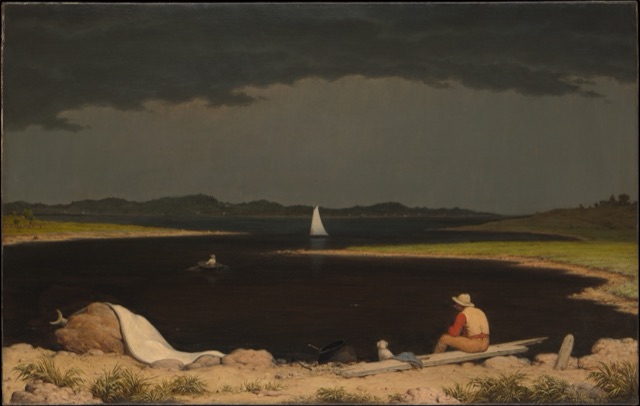 1859
Approaching Thunder Storm
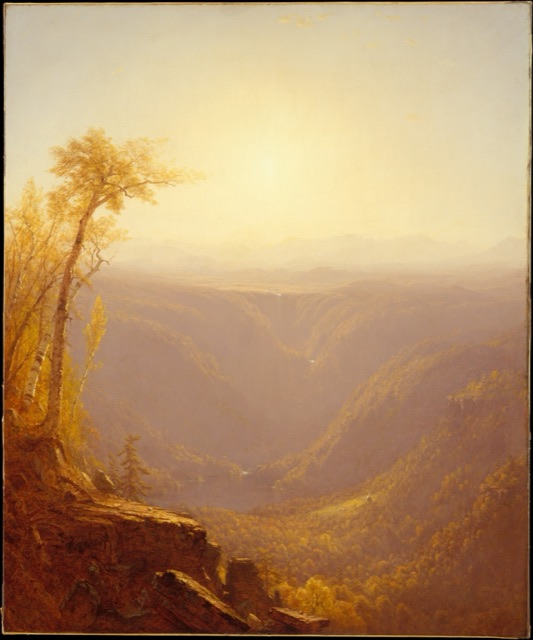 1862
A Gorge in the Mountains (Kauterskill Clove)
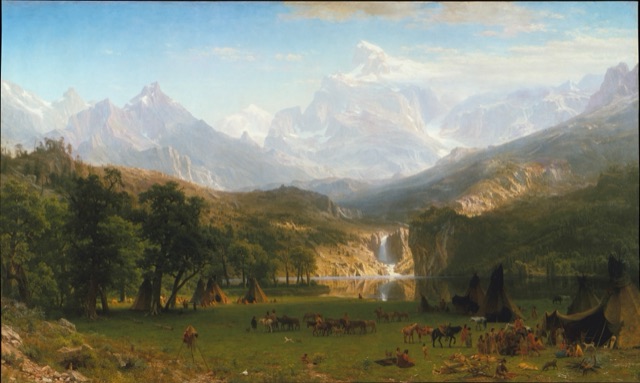 1863
The Rocky Mountains, Lander's Peak
 1836