1361–1862 · 5 works · Art Institute of Chicago · The Metropolitan Museum of Art
Horizons East and West: Chinese Scrolls and the American Sublime
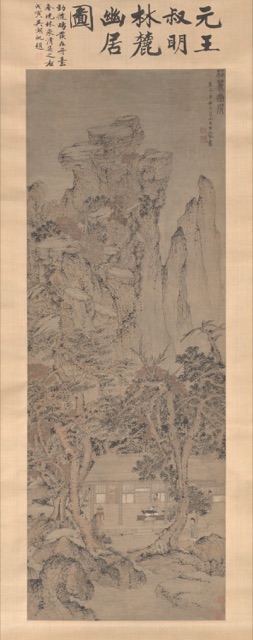
Stop 1 of 5 · Wang Meng · Yuan dynasty (1279–1368), dated 1361
Quiet Life in a Wooded Glen 林麓幽居圖
First Look
Look at the open-fronted cottage near the bottom of the scroll. A man is kneeling inside with a zither on the table in front of him, and servants wait nearby. Everything above him is mountain: rock piled on rock, with twisted pines growing out of the seams. Wang Meng painted this in thirteen sixty-one. It is a picture of a scholar who has left the world of office and gone to live among the hills.
A closer look
Come close to any of the rocks. They are built from thousands of short, dry strokes and dots, laid over one another until the surface seems to move. That restless brushwork is Wang Meng’s own. He was the youngest of the painters later called the Four Great Masters of the Yuan dynasty, the period when the Mongols ruled China. Many educated men then stayed out of government, and they made painting a way of speaking about themselves. Wang Meng had served as a legal clerk, and in the unsettled last years of Mongol rule he withdrew to a mountain retreat. The Art Institute suggests that this scroll may be a kind of self-portrait. He wrote the title and the date at the upper right of the painting. The large characters across the top, above the picture, were added by a later hand.
A scholar plays the zither in a cottage at the foot of towering, crowded mountains. Wang Meng, one of the Four Great Masters of the Yuan dynasty, painted it in 1361. Hanging scroll, ink and light colours on paper; the painting is 177.8 × 64.2 cm and is shown with its title panel and mount.
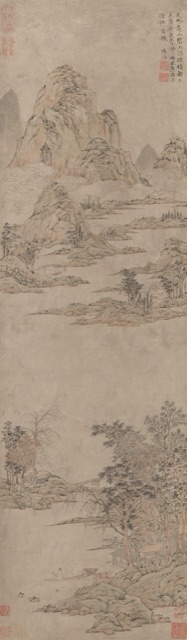
Stop 2 of 5 · Lu Zhi · Ming dynasty (1368–1644); c. 1545
Pulling Oars under Clearing Autumn Skies 晴秋涉櫂圖
First Look
Look near the bottom of the scroll, just off the rocky bank. A man in a pale robe is sitting in a small boat. He is tiny, and the river around him is nothing but blank paper. Now let your eyes rise slowly, bank by bank, to the peaks at the top. Lu Zhi painted this around fifteen forty-five. In his poem, written at the upper right, he says he is feasting his eyes on the cold river in autumn.
A closer look
Notice how the picture is put together. There is no single viewpoint. The scroll is a stack of separate shorelines, each seen from a little higher than the one below, and the unpainted paper between them serves as water and mist. A Chinese painter expected the viewer to travel through a landscape, not to stand in front of it. Lu Zhi lived near Suzhou, the richest and most cultivated city of Ming dynasty China, and studied with its leading painter, Wen Zhengming. Like his teacher he belonged to the class of educated men who painted for themselves and their friends. His own manner is crisp and angular: look at the mountains, drawn with fine dry lines and touched with pale orange and green. The Art Institute describes the result as an image of great clarity and refinement.
A tall, narrow view of a river in autumn: jagged peaks at the top, a single boat near the bottom, and a great deal of empty paper between. Lu Zhi wrote a poem on it about watching the cold river from his boat. Hanging scroll, ink and colour on paper, 105.8 × 31.1 cm.
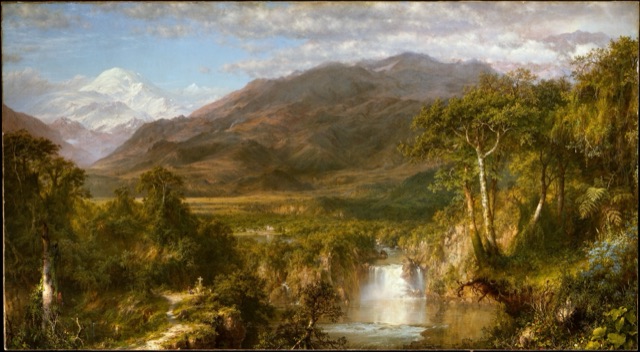
Stop 3 of 5 · Frederic Edwin Church · 1859
Heart of the Andes
First Look
Look at the sunlit tree trunk at the lower left. Frederic Church cut his name and the year into its bark, in paint. Then let your eyes travel: along the path to a white cross where two people have stopped, across the pool and the waterfall, and up to the snow peak in the far distance. Church painted this in eighteen fifty-nine from sketches made in Ecuador. No single place looks like this.
A closer look
Come close and pick any patch of the foreground: ferns, vines, butterflies, birds in the branches. Each plant is painted exactly enough for a botanist to name it. Church had travelled to South America twice in the eighteen fifties, following the route of the German naturalist Alexander von Humboldt, who believed that the tropics showed the whole order of nature in one landscape, from jungle floor to ice. The painting was Church’s answer. In the spring of eighteen fifty-nine he showed it by itself in a darkened room in New York, in a frame built to look like a window, and twelve thousand people paid twenty-five cents each to see it. Many brought opera glasses and explored it piece by piece, as you can here. It sold for ten thousand dollars, then the highest price paid for a work by a living American artist.
A composite of the mountains, forests and rivers Church had sketched in Ecuador, painted three metres wide in his New York studio. In 1859 crowds paid to see it shown alone, and studied it through opera glasses. Oil on canvas, 168 × 302.9 cm.
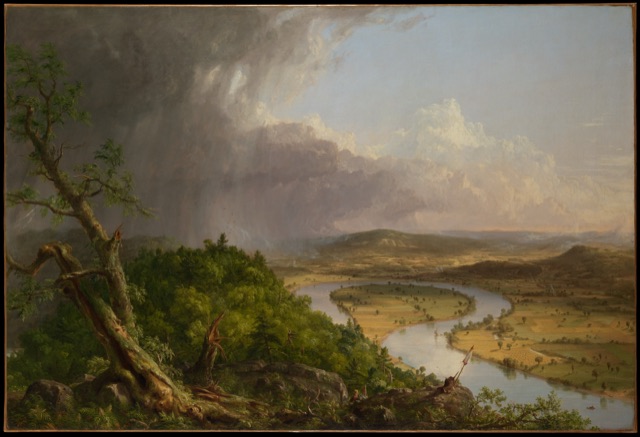
Stop 4 of 5 · Thomas Cole · 1836
View from Mount Holyoke, Northampton, Massachusetts, after a Thunderstorm—The Oxbow
First Look
Look at the rocks in the lower centre of the canvas, just left of the furled umbrella. A small figure in a hat is sitting there at an easel, turned to look back at us. That is the painter, Thomas Cole. He made this view of the Connecticut River in eighteen thirty-six. On the left the storm is leaving over wild forest. On the right the sun is already on the fields.
A closer look
Step back and let the picture divide in two. A diagonal runs from the shattered tree at the lower left to the far hills. Above and left of it are storm cloud and untouched forest. Below and right are fields, boats on the river and threads of smoke from farmhouses. Cole was born in England and came to America as a young man, and he became the first great painter of its scenery. He admired the wild country and worried about how quickly it was being cleared. This canvas, shown in New York in eighteen thirty-six, holds both feelings in a single view, and he does not say which side he is on. The loop of the river gave the painting its familiar name, The Oxbow. Follow its curve once more. Some people see a question mark drawn on the valley floor.
From a hilltop in Massachusetts, a storm moves off to the left over broken forest while sunlight returns to the farmland in the loop of the Connecticut River. Cole painted himself into the foreground, at work. Oil on canvas, 130.8 × 193 cm.
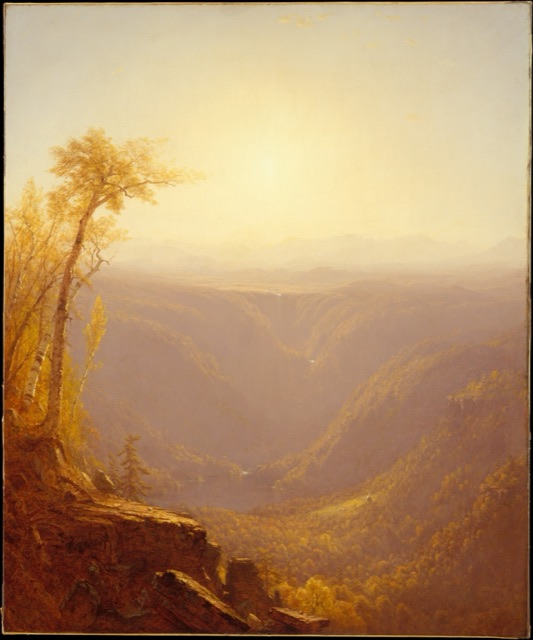
Stop 5 of 5 · Sanford Robinson Gifford · 1862
A Gorge in the Mountains (Kauterskill Clove)
First Look
Look straight into the brightest part of the picture, where the sun sits just above the far ridge. Almost nothing there has an edge. Sanford Gifford has painted the air itself, thick with gold light, and let the valley sink into it. This is Kaaterskill Clove in the Catskill Mountains of New York, in eighteen sixty-two. On the ledge at the lower left, nearly lost in the red rock, a hunter and his dog are climbing up into the view.
A closer look
Find the small pale glint far down the valley, almost lost in the haze. It is water, at the head of the gorge. A few miles from here Thomas Cole had made his first sketches of the Catskills nearly forty years earlier, and by Gifford’s time the clove was among the best known pieces of wild scenery in America. Gifford had grown up nearby and painted it again and again. He was less interested in rocks and trees than in what light does to distance, and he finished his pictures with thin warm glazes that bind everything into one tone. The date matters too. In eighteen sixty-two the Civil War was in its second year, and Gifford was serving with a New York regiment between painting seasons. This is a view of home, made in wartime, and it is entirely at peace.
The whole valley of Kaaterskill Clove in the Catskill Mountains dissolves in late sun. Gifford’s real subject is the lit haze itself; landscape painting, he said, is air painting. Oil on canvas, 121.9 × 101.3 cm.
Yuan dynasty (1279–1368), dated 1361Quiet Life in a Wooded Glen 林麓幽居圖
A scholar plays the zither in a cottage at the foot of towering, crowded mountains. Wang Meng, one of the Four Great Masters of the Yuan dynasty, painted it in 1361. Hanging scroll, ink and light colours on paper; the painting is 177.8 × 64.2 cm and is shown with its title panel and mount.
Ming dynasty (1368–1644); c. 1545Pulling Oars under Clearing Autumn Skies 晴秋涉櫂圖
A tall, narrow view of a river in autumn: jagged peaks at the top, a single boat near the bottom, and a great deal of empty paper between. Lu Zhi wrote a poem on it about watching the cold river from his boat. Hanging scroll, ink and colour on paper, 105.8 × 31.1 cm.
1859Heart of the Andes
A composite of the mountains, forests and rivers Church had sketched in Ecuador, painted three metres wide in his New York studio. In 1859 crowds paid to see it shown alone, and studied it through opera glasses. Oil on canvas, 168 × 302.9 cm.
1836View from Mount Holyoke, Northampton, Massachusetts, after a…
From a hilltop in Massachusetts, a storm moves off to the left over broken forest while sunlight returns to the farmland in the loop of the Connecticut River. Cole painted himself into the foreground, at work. Oil on canvas, 130.8 × 193 cm.
1862A Gorge in the Mountains (Kauterskill Clove)
The whole valley of Kaaterskill Clove in the Catskill Mountains dissolves in late sun. Gifford’s real subject is the lit haze itself; landscape painting, he said, is air painting. Oil on canvas, 121.9 × 101.3 cm.
Other exhibitions
The Sistine Chapel: Ceiling, Altar, and Wall Cycles
Michelangelo’s ceiling and Last Judgment alongside the fifteenth-century north and south wall narratives by Botticelli, Perugino, Ghirlandaio, Rosselli, and Signorelli.
1765–1857 · 7 worksEdo: Pictures of the Floating World
Seven woodblock prints from the city of Edo, 1765 to 1857: Harunobu, Kiyonaga, Sharaku, Utamaro and Hiroshige, from the Art Institute of Chicago.
1867–1893 · 7 worksImpressionism: Painters of Modern Life
Seven painters and seven views of modern France, 1867 to 1893: Monet, Renoir, Morisot, Caillebotte, Degas, Cassatt and Pissarro, from the Art Institute of Chicago.
1782–1893 · 6 worksFrom Edo to Paris: Ukiyo-e and the Impressionist Eye
How Japanese woodblock masters Hiroshige and Kiyonaga inspired the cropped framing, asymmetric diagonals, and rain-swept streets of Caillebotte, Degas, and Cassatt.