Pulling Oars under Clearing Autumn Skies 晴秋涉櫂圖
Stop 1 · First look
First Look
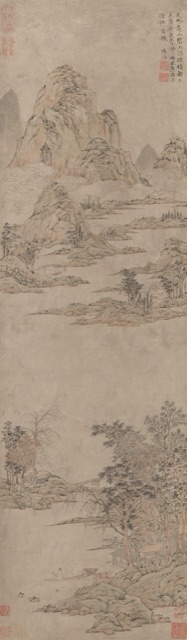
Look near the bottom of the scroll, just off the rocky bank. A man in a pale robe is sitting in a small boat. He is tiny, and the river around him is nothing but blank paper. Now let your eyes rise slowly, bank by bank, to the peaks at the top. Lu Zhi painted this around fifteen forty-five. In his poem, written at the upper right, he says he is feasting his eyes on the cold river in autumn.
Stop 2 · Technique
Closer Reading
Notice how the picture is put together. There is no single viewpoint. The scroll is a stack of separate shorelines, each seen from a little higher than the one below, and the unpainted paper between them serves as water and mist. A Chinese painter expected the viewer to travel through a landscape, not to stand in front of it. Lu Zhi lived near Suzhou, the richest and most cultivated city of Ming dynasty China, and studied with its leading painter, Wen Zhengming. Like his teacher he belonged to the class of educated men who painted for themselves and their friends. His own manner is crisp and angular: look at the mountains, drawn with fine dry lines and touched with pale orange and green. The Art Institute describes the result as an image of great clarity and refinement.
Stop 3 · Museum record
Catalog Summary
A tall, narrow view of a river in autumn: jagged peaks at the top, a single boat near the bottom, and a great deal of empty paper between. Lu Zhi wrote a poem on it about watching the cold river from his boat. Hanging scroll, ink and colour on paper, 105.8 × 31.1 cm.
Recorded physical scale: 31.1 × 105.8 cm (12.2 × 41.7 in · 0.31 × 1.06 m).
Stop 4 · Historical Context
Lu Zhi (1496–1576)
Gentleman painter and poet of Suzhou, a pupil of Wen Zhengming, known for crisp, clear landscapes with an almost luminous look.
Chinese literati painting (Yuan to Qing dynasties, late 13th to early 20th century): The Chinese tradition of scholar-amateur painting, which valued personal brushwork, poetry and the study of old masters above lifelike description.
First Look
Look near the bottom of the scroll, just off the rocky bank. A man in a pale robe is sitting in a small boat. He is tiny, and the river around him is nothing but blank paper. Now let your eyes rise slowly, bank by bank, to the peaks at the top. Lu Zhi painted this around fifteen forty-five. In his poem, written at the upper right, he says he is feasting his eyes on the cold river in autumn.
Closer Reading
Notice how the picture is put together. There is no single viewpoint. The scroll is a stack of separate shorelines, each seen from a little higher than the one below, and the unpainted paper between them serves as water and mist. A Chinese painter expected the viewer to travel through a landscape, not to stand in front of it. Lu Zhi lived near Suzhou, the richest and most cultivated city of Ming dynasty China, and studied with its leading painter, Wen Zhengming. Like his teacher he belonged to the class of educated men who painted for themselves and their friends. His own manner is crisp and angular: look at the mountains, drawn with fine dry lines and touched with pale orange and green. The Art Institute describes the result as an image of great clarity and refinement.
Catalog Summary
A tall, narrow view of a river in autumn: jagged peaks at the top, a single boat near the bottom, and a great deal of empty paper between. Lu Zhi wrote a poem on it about watching the cold river from his boat. Hanging scroll, ink and colour on paper, 105.8 × 31.1 cm.
About the Artist
Lu Zhi (1496–1576)
Lu Zhi belonged to the Wu school, the circle of gentleman artists in the wealthy city of Suzhou. Most records give his birth year as 1496, though 1495 is also found. He was one of the highly educated men who painted for their own pleasure, and was also a poet. He was a pupil of Wen Zhengming, who led the Wu school for decades.
Lu Zhi carried his teacher's manner in a new direction and arrived at a landscape style of his own, clear and almost luminous. Jagged peaks stand in separate layers of distance, bare paper opens into a wide river, and each stroke is placed with great precision. On one such picture he wrote a poem about watching the cold river in autumn from his boat. He also painted scenes from famous poems, among them the Lute Song by the Tang poet Bai Juyi.
He outlived Wen Zhengming by seventeen years and died in 1576. In the decades that followed, the Wu school slowly lost its leading place as rival towns in the Yangzi delta grew.
Related works
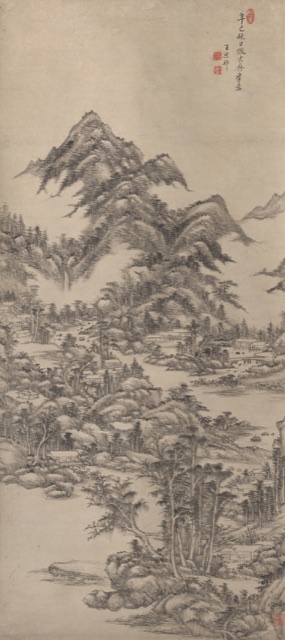 Qing Dynasty (1644–1911); dated 1701
Landscape after Huang Gongwang
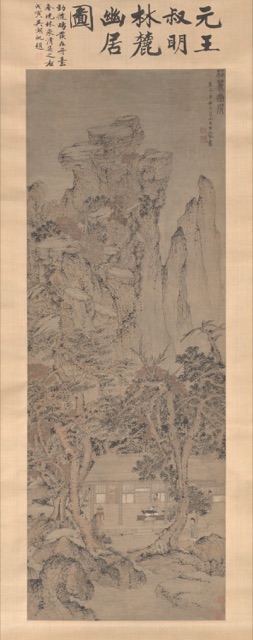 Yuan dynasty (1279–1368), dated 1361
Quiet Life in a Wooded Glen 林麓幽居圖
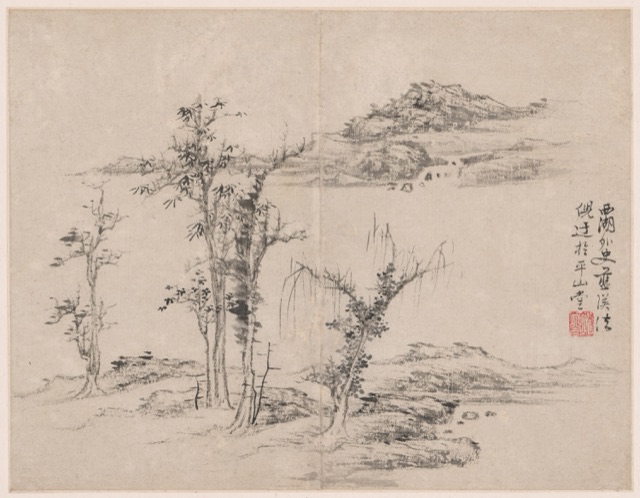 Ming dynasty (1368–1644), first half of 17th century
Landscape in the Style of Ancient Masters: after Ni Zan
 Ming dynasty (1368–1644), first half of 17th century