1361–1701 · 5 works · Art Institute of Chicago
Mountains and Water: Chinese Landscape Painting
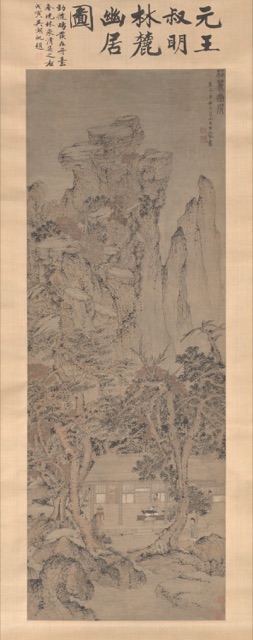
Stop 1 of 5 · Wang Meng · Yuan dynasty (1279–1368), dated 1361
Quiet Life in a Wooded Glen 林麓幽居圖
First Look
Look at the open-fronted cottage near the bottom of the scroll. A man is kneeling inside with a zither on the table in front of him, and servants wait nearby. Everything above him is mountain: rock piled on rock, with twisted pines growing out of the seams. Wang Meng painted this in thirteen sixty-one. It is a picture of a scholar who has left the world of office and gone to live among the hills.
A closer look
Come close to any of the rocks. They are built from thousands of short, dry strokes and dots, laid over one another until the surface seems to move. That restless brushwork is Wang Meng’s own. He was the youngest of the painters later called the Four Great Masters of the Yuan dynasty, the period when the Mongols ruled China. Many educated men then stayed out of government, and they made painting a way of speaking about themselves. Wang Meng had served as a legal clerk, and in the unsettled last years of Mongol rule he withdrew to a mountain retreat. The Art Institute suggests that this scroll may be a kind of self-portrait. He wrote the title and the date at the upper right of the painting. The large characters across the top, above the picture, were added by a later hand.
A scholar plays the zither in a cottage at the foot of towering, crowded mountains. Wang Meng, one of the Four Great Masters of the Yuan dynasty, painted it in 1361. Hanging scroll, ink and light colours on paper; the painting is 177.8 × 64.2 cm and is shown with its title panel and mount.
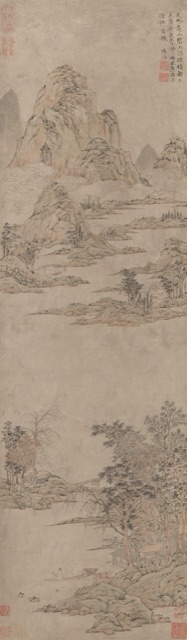
Stop 2 of 5 · Lu Zhi · Ming dynasty (1368–1644); c. 1545
Pulling Oars under Clearing Autumn Skies 晴秋涉櫂圖
First Look
Look near the bottom of the scroll, just off the rocky bank. A man in a pale robe is sitting in a small boat. He is tiny, and the river around him is nothing but blank paper. Now let your eyes rise slowly, bank by bank, to the peaks at the top. Lu Zhi painted this around fifteen forty-five. In his poem, written at the upper right, he says he is feasting his eyes on the cold river in autumn.
A closer look
Notice how the picture is put together. There is no single viewpoint. The scroll is a stack of separate shorelines, each seen from a little higher than the one below, and the unpainted paper between them serves as water and mist. A Chinese painter expected the viewer to travel through a landscape, not to stand in front of it. Lu Zhi lived near Suzhou, the richest and most cultivated city of Ming dynasty China, and studied with its leading painter, Wen Zhengming. Like his teacher he belonged to the class of educated men who painted for themselves and their friends. His own manner is crisp and angular: look at the mountains, drawn with fine dry lines and touched with pale orange and green. The Art Institute describes the result as an image of great clarity and refinement.
A tall, narrow view of a river in autumn: jagged peaks at the top, a single boat near the bottom, and a great deal of empty paper between. Lu Zhi wrote a poem on it about watching the cold river from his boat. Hanging scroll, ink and colour on paper, 105.8 × 31.1 cm.
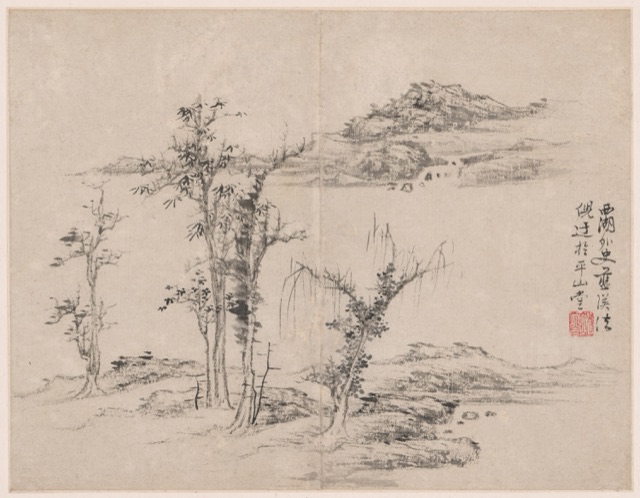
Stop 3 of 5 · Lan Ying · Ming dynasty (1368–1644), first half of 17th century
Landscape in the Style of Ancient Masters: after Ni Zan (1301-1374)
First Look
Look at the group of thin trees in the middle of the sheet. There are no people and almost no ink: a bank, some bare branches, a far shore. This spare arrangement was invented by the fourteenth-century painter Ni Zan, and by the sixteen hundreds every educated viewer knew it on sight. Lan Ying is quoting it here, the way a musician plays a famous tune. His inscription at the right says so.
A closer look
Notice the brush. The ink is dry, so each stroke breaks up on the paper and leaves a pale, chalky line. Ni Zan was famous for exactly that, and for a manner so plain that later writers called it cold. He was one of the Four Great Masters of the Yuan dynasty, along with Wang Meng, whose scroll hangs in this room. Lan Ying worked in the city of Hangzhou some three hundred years later. He was a professional who sold his pictures, and he made his name with albums like this one, in which each leaf takes up the manner of a different old master. In China that was not copying. A painter was expected to know the tradition by hand, and to show his own character in how he handled it. Lan Ying’s trees are a little fuller and livelier than Ni Zan’s would be. The album this leaf comes from is dated sixteen forty-two.
A few thin trees on a bank, a stretch of empty water, low hills beyond. Lan Ying painted this leaf in the manner of Ni Zan, a master who had lived three centuries earlier, as one of a set of landscapes after the old painters. Album leaf, ink and colour on paper, 31 × 40.7 cm.
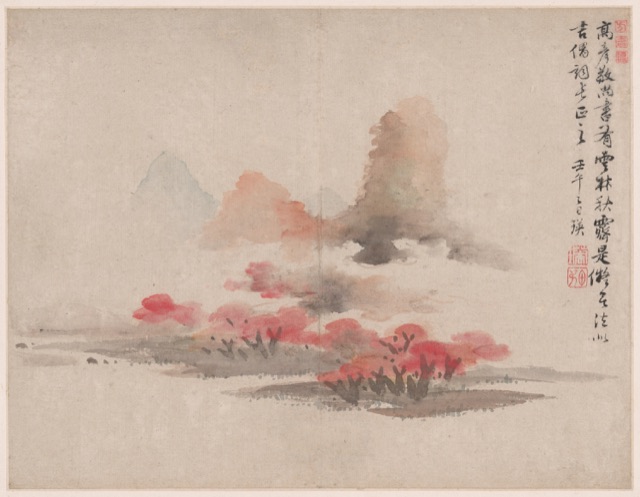
Stop 4 of 5 · Lan Ying · Ming dynasty (1368–1644), first half of 17th century
Landscape in the Style of Ancient Masters: after Gao Kegong
First Look
Look at the red trees along the bottom of the sheet, and then at the mountains above them. The mountains have no outlines. They are pools of wet colour, orange, grey and pale blue, left to spread into the paper like cloud. Lan Ying painted this in sixteen forty-two. His inscription names his model, an earlier master known for hills half hidden in mist, and his subject: a forest clearing after autumn rain.
A closer look
Compare this leaf with its neighbour. They come from the same album and the same year, and they could hardly be more different. One is dry line and bare paper. This one is all water and colour, and the brush has scarcely drawn anything. That contrast is the point of such an album. Each leaf takes up another old master, and here it is Gao Kegong, an official of the early Yuan dynasty who painted rounded mountains wrapped in wet mist. Chinese writers called this way of working boneless, because the forms have no skeleton of ink line. Lan Ying was known for his range, and he lived through hard years: two years after he dated this album, the Ming dynasty fell. Notice the far peak at the left, a single touch of blue. It sets the distance for the whole view.
Red autumn trees stand in mist below mountains made of soft washes of colour, with hardly an outline anywhere. On this leaf Lan Ying follows Gao Kegong, a painter of cloudy hills who died in 1310, and dates his own work to 1642. Album leaf, ink and colour on paper, 31 × 40.7 cm.
Stop 5 of 5 · Wang Yuanqi · Qing Dynasty (1644–1911); dated 1701
Landscape after Huang Gongwang
First Look
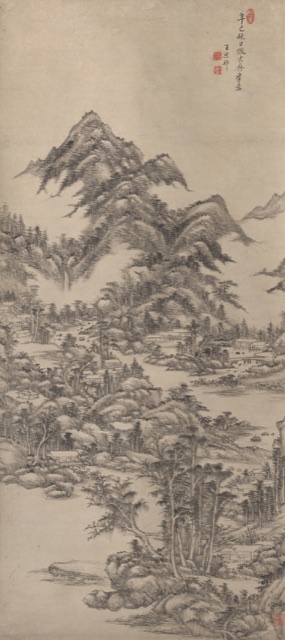
Look at the main peak, and at the smaller shapes it is made of. Wang Yuanqi has stacked them like blocks, one behind another, so the mountain seems to push upward as you watch. Below it are roofs among the trees and a thin waterfall on the left. He painted this in the autumn of seventeen oh one. His inscription at the upper right says he was following the brush manner of Huang Gongwang, who had died almost three hundred and fifty years before.
A closer look
Stand back from the scroll and half close your eyes. The details fall away and you see a pattern of dark and light masses climbing from the trees at the bottom to the summit, tilting one way and then the other. Wang Yuanqi cared about that structure more than about any actual place. He compared the hidden line of force running through a painted mountain to the veins of a dragon. He was the youngest of four painters, all named Wang, who led what was called the orthodox school, and he rose to high office under the Kangxi emperor, advising the court on its collection of paintings. For these men the Yuan master Huang Gongwang was the model above all others, and Wang Yuanqi returned to him throughout his life. Come close again and look at how the forms are made: dry strokes laid over pale ones, layer upon layer, with only a few touches of colour.
A mountain built up from dozens of small rounded forms rises over a valley of houses and a foreground of tall trees. Wang Yuanqi, a senior official at the court of the Kangxi emperor, inscribed it in 1701 as painted in the manner of the Yuan master Huang Gongwang. Hanging scroll, ink and colour on paper, 129.6 × 58.5 cm.
Yuan dynasty (1279–1368), dated 1361Quiet Life in a Wooded Glen 林麓幽居圖
A scholar plays the zither in a cottage at the foot of towering, crowded mountains. Wang Meng, one of the Four Great Masters of the Yuan dynasty, painted it in 1361. Hanging scroll, ink and light colours on paper; the painting is 177.8 × 64.2 cm and is shown with its title panel and mount.
Ming dynasty (1368–1644); c. 1545Pulling Oars under Clearing Autumn Skies 晴秋涉櫂圖
A tall, narrow view of a river in autumn: jagged peaks at the top, a single boat near the bottom, and a great deal of empty paper between. Lu Zhi wrote a poem on it about watching the cold river from his boat. Hanging scroll, ink and colour on paper, 105.8 × 31.1 cm.
Ming dynasty (1368–1644), first half of 17th centuryLandscape in the Style of Ancient Masters: after Ni Zan
A few thin trees on a bank, a stretch of empty water, low hills beyond. Lan Ying painted this leaf in the manner of Ni Zan, a master who had lived three centuries earlier, as one of a set of landscapes after the old painters. Album leaf, ink and colour on paper, 31 × 40.7 cm.
Ming dynasty (1368–1644), first half of 17th centuryLandscape in the Style of Ancient Masters: after Gao Kegong
Red autumn trees stand in mist below mountains made of soft washes of colour, with hardly an outline anywhere. On this leaf Lan Ying follows Gao Kegong, a painter of cloudy hills who died in 1310, and dates his own work to 1642. Album leaf, ink and colour on paper, 31 × 40.7 cm.
Qing Dynasty (1644–1911); dated 1701Landscape after Huang Gongwang
A mountain built up from dozens of small rounded forms rises over a valley of houses and a foreground of tall trees. Wang Yuanqi, a senior official at the court of the Kangxi emperor, inscribed it in 1701 as painted in the manner of the Yuan master Huang Gongwang. Hanging scroll, ink and colour on paper, 129.6 × 58.5 cm.
Other exhibitions
The Sistine Chapel: Ceiling, Altar, and Wall Cycles
Michelangelo’s ceiling and Last Judgment alongside the fifteenth-century north and south wall narratives by Botticelli, Perugino, Ghirlandaio, Rosselli, and Signorelli.
1765–1857 · 7 worksEdo: Pictures of the Floating World
Seven woodblock prints from the city of Edo, 1765 to 1857: Harunobu, Kiyonaga, Sharaku, Utamaro and Hiroshige, from the Art Institute of Chicago.
1867–1893 · 7 worksImpressionism: Painters of Modern Life
Seven painters and seven views of modern France, 1867 to 1893: Monet, Renoir, Morisot, Caillebotte, Degas, Cassatt and Pissarro, from the Art Institute of Chicago.
1782–1893 · 6 worksFrom Edo to Paris: Ukiyo-e and the Impressionist Eye
How Japanese woodblock masters Hiroshige and Kiyonaga inspired the cropped framing, asymmetric diagonals, and rain-swept streets of Caillebotte, Degas, and Cassatt.