Landscape in the Style of Ancient Masters: after Gao Kegong
Stop 1 · First look
First Look
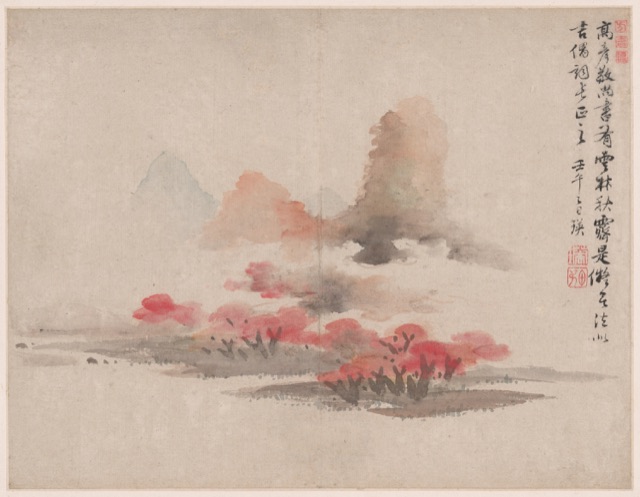
Look at the red trees along the bottom of the sheet, and then at the mountains above them. The mountains have no outlines. They are pools of wet colour, orange, grey and pale blue, left to spread into the paper like cloud. Lan Ying painted this in sixteen forty-two. His inscription names his model, an earlier master known for hills half hidden in mist, and his subject: a forest clearing after autumn rain.
Stop 2 · Technique
Closer Reading
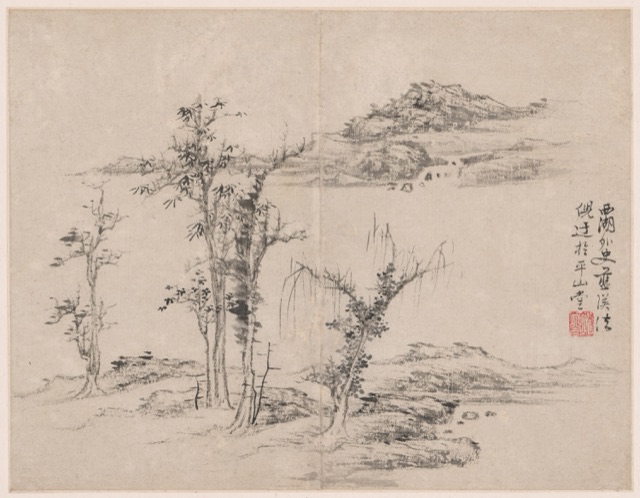
Compare this leaf with its neighbour. They come from the same album and the same year, and they could hardly be more different. One is dry line and bare paper. This one is all water and colour, and the brush has scarcely drawn anything. That contrast is the point of such an album. Each leaf takes up another old master, and here it is Gao Kegong, an official of the early Yuan dynasty who painted rounded mountains wrapped in wet mist. Chinese writers called this way of working boneless, because the forms have no skeleton of ink line. Lan Ying was known for his range, and he lived through hard years: two years after he dated this album, the Ming dynasty fell. Notice the far peak at the left, a single touch of blue. It sets the distance for the whole view.
Stop 3 · Museum record
Catalog Summary
Red autumn trees stand in mist below mountains made of soft washes of colour, with hardly an outline anywhere. On this leaf Lan Ying follows Gao Kegong, a painter of cloudy hills who died in 1310, and dates his own work to 1642. Album leaf, ink and colour on paper, 31 × 40.7 cm.
Recorded physical scale: 40.7 × 31.0 cm (16.0 × 12.2 in · 0.41 × 0.31 m).
Stop 4 · Historical Context
Lan Ying (1585–c. 1664)
Professional painter from Hangzhou, often called the last master of the Zhe school, who also learned to paint in the manner of many old masters.
Zhe school (Ming dynasty, 15th to mid-17th century): A tradition of professional and court painters in Ming-dynasty China, named after Zhejiang province and known for dramatic landscapes and bold, expressive brushwork.
First Look
Look at the red trees along the bottom of the sheet, and then at the mountains above them. The mountains have no outlines. They are pools of wet colour, orange, grey and pale blue, left to spread into the paper like cloud. Lan Ying painted this in sixteen forty-two. His inscription names his model, an earlier master known for hills half hidden in mist, and his subject: a forest clearing after autumn rain.
Closer Reading
Compare this leaf with its neighbour. They come from the same album and the same year, and they could hardly be more different. One is dry line and bare paper. This one is all water and colour, and the brush has scarcely drawn anything. That contrast is the point of such an album. Each leaf takes up another old master, and here it is Gao Kegong, an official of the early Yuan dynasty who painted rounded mountains wrapped in wet mist. Chinese writers called this way of working boneless, because the forms have no skeleton of ink line. Lan Ying was known for his range, and he lived through hard years: two years after he dated this album, the Ming dynasty fell. Notice the far peak at the left, a single touch of blue. It sets the distance for the whole view.
Catalog Summary
Red autumn trees stand in mist below mountains made of soft washes of colour, with hardly an outline anywhere. On this leaf Lan Ying follows Gao Kegong, a painter of cloudy hills who died in 1310, and dates his own work to 1642. Album leaf, ink and colour on paper, 31 × 40.7 cm.
About the Artist
Lan Ying (1585–c. 1664)
Lan Ying was born in Hangzhou and decided early to become a famous painter. He was a professional, not a scholar-amateur, and is often called the last important master of the Zhe school, a tradition of professional painters. His dates are uncertain: usually 1585 to about 1664, sometimes 1578 to 1660.
Yet he knew the scholars' world well. He was in close contact with literati such as Dong Qichang and Chen Jiru, who shared their views with him and opened their collections of old paintings. From these he learned the methods of many earlier masters, a practice called fang, or imitation, and used them to widen his own range. In one set of landscapes in the style of ancient masters he follows Gao Kegong, Ni Zan, Fang Congyi and Wang Meng, and he also paid homage to Huang Gongwang.
His landscapes can show more decorative brushwork and richer colour than the orthodox manner of the scholar-painters. He formed a style of his own and inspired younger painters, among them Chen Hongshou and Liu Du.
Related works
 Ming dynasty (1368–1644), first half of 17th century
Landscape in the Style of Ancient Masters: after Ni Zan
 Qing Dynasty (1644–1911); dated 1701
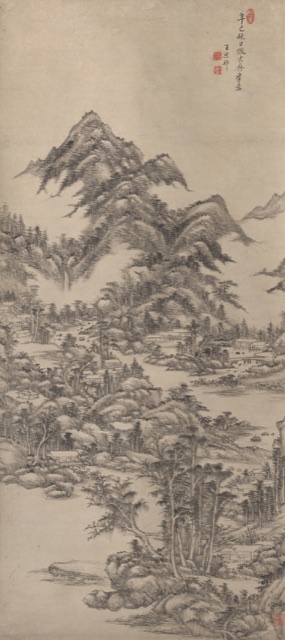
Landscape after Huang Gongwang
 Ming dynasty (1368–1644); c. 1545
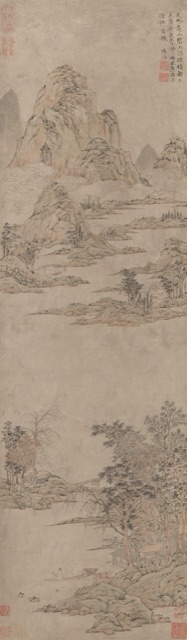
Pulling Oars under Clearing Autumn Skies 晴秋涉櫂圖
 Yuan dynasty (1279–1368), dated 1361