Landscape in the Style of Ancient Masters: after Ni Zan (1301-1374)
Stop 1 · First look
First Look
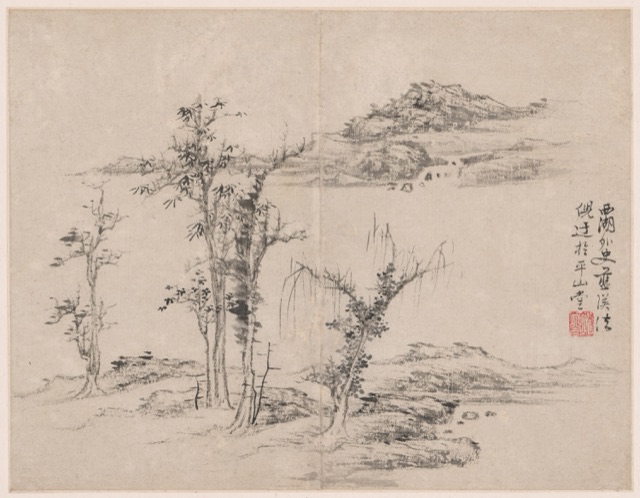
Look at the group of thin trees in the middle of the sheet. There are no people and almost no ink: a bank, some bare branches, a far shore. This spare arrangement was invented by the fourteenth-century painter Ni Zan, and by the sixteen hundreds every educated viewer knew it on sight. Lan Ying is quoting it here, the way a musician plays a famous tune. His inscription at the right says so.
Stop 2 · Technique
Closer Reading
Notice the brush. The ink is dry, so each stroke breaks up on the paper and leaves a pale, chalky line. Ni Zan was famous for exactly that, and for a manner so plain that later writers called it cold. He was one of the Four Great Masters of the Yuan dynasty, along with Wang Meng, whose scroll hangs in this room. Lan Ying worked in the city of Hangzhou some three hundred years later. He was a professional who sold his pictures, and he made his name with albums like this one, in which each leaf takes up the manner of a different old master. In China that was not copying. A painter was expected to know the tradition by hand, and to show his own character in how he handled it. Lan Ying’s trees are a little fuller and livelier than Ni Zan’s would be. The album this leaf comes from is dated sixteen forty-two.
Stop 3 · Museum record
Catalog Summary
A few thin trees on a bank, a stretch of empty water, low hills beyond. Lan Ying painted this leaf in the manner of Ni Zan, a master who had lived three centuries earlier, as one of a set of landscapes after the old painters. Album leaf, ink and colour on paper, 31 × 40.7 cm.
Recorded physical scale: 40.7 × 31.0 cm (16.0 × 12.2 in · 0.41 × 0.31 m).
Stop 4 · Historical Context
Lan Ying (1585–c. 1664)
Professional painter from Hangzhou, often called the last master of the Zhe school, who also learned to paint in the manner of many old masters.
Zhe school (Ming dynasty, 15th to mid-17th century): A tradition of professional and court painters in Ming-dynasty China, named after Zhejiang province and known for dramatic landscapes and bold, expressive brushwork.
First Look
Look at the group of thin trees in the middle of the sheet. There are no people and almost no ink: a bank, some bare branches, a far shore. This spare arrangement was invented by the fourteenth-century painter Ni Zan, and by the sixteen hundreds every educated viewer knew it on sight. Lan Ying is quoting it here, the way a musician plays a famous tune. His inscription at the right says so.
Closer Reading
Notice the brush. The ink is dry, so each stroke breaks up on the paper and leaves a pale, chalky line. Ni Zan was famous for exactly that, and for a manner so plain that later writers called it cold. He was one of the Four Great Masters of the Yuan dynasty, along with Wang Meng, whose scroll hangs in this room. Lan Ying worked in the city of Hangzhou some three hundred years later. He was a professional who sold his pictures, and he made his name with albums like this one, in which each leaf takes up the manner of a different old master. In China that was not copying. A painter was expected to know the tradition by hand, and to show his own character in how he handled it. Lan Ying’s trees are a little fuller and livelier than Ni Zan’s would be. The album this leaf comes from is dated sixteen forty-two.
Catalog Summary
A few thin trees on a bank, a stretch of empty water, low hills beyond. Lan Ying painted this leaf in the manner of Ni Zan, a master who had lived three centuries earlier, as one of a set of landscapes after the old painters. Album leaf, ink and colour on paper, 31 × 40.7 cm.
About the Artist
Lan Ying (1585–c. 1664)
Lan Ying was born in Hangzhou and decided early to become a famous painter. He was a professional, not a scholar-amateur, and is often called the last important master of the Zhe school, a tradition of professional painters. His dates are uncertain: usually 1585 to about 1664, sometimes 1578 to 1660.
Yet he knew the scholars' world well. He was in close contact with literati such as Dong Qichang and Chen Jiru, who shared their views with him and opened their collections of old paintings. From these he learned the methods of many earlier masters, a practice called fang, or imitation, and used them to widen his own range. In one set of landscapes in the style of ancient masters he follows Gao Kegong, Ni Zan, Fang Congyi and Wang Meng, and he also paid homage to Huang Gongwang.
His landscapes can show more decorative brushwork and richer colour than the orthodox manner of the scholar-painters. He formed a style of his own and inspired younger painters, among them Chen Hongshou and Liu Du.
Related works
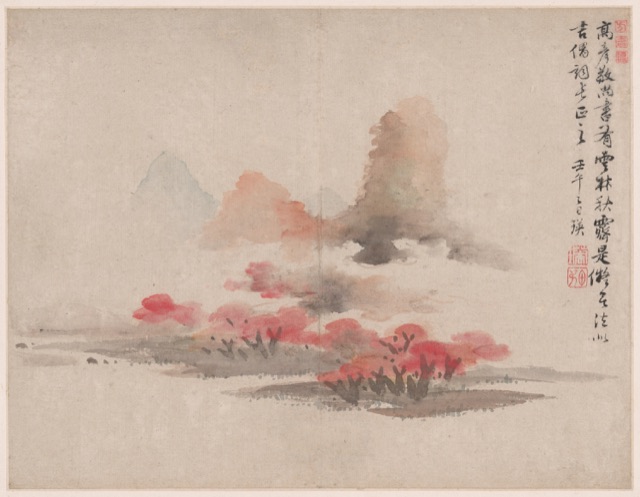 Ming dynasty (1368–1644), first half of 17th century
Landscape in the Style of Ancient Masters: after Gao Kegong
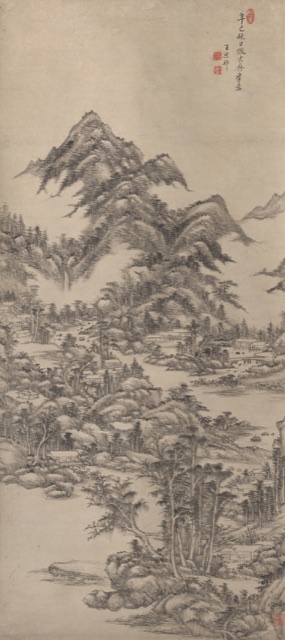 Qing Dynasty (1644–1911); dated 1701
Landscape after Huang Gongwang
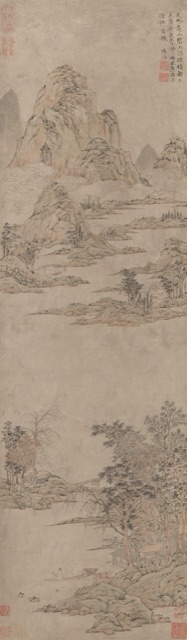 Ming dynasty (1368–1644); c. 1545
Pulling Oars under Clearing Autumn Skies 晴秋涉櫂圖
 Yuan dynasty (1279–1368), dated 1361