Landscape after Huang Gongwang
Stop 1 · First look
First Look
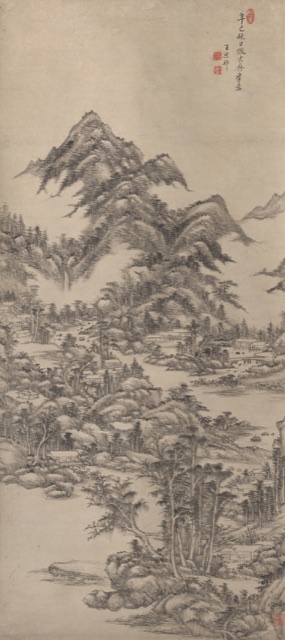
Look at the main peak, and at the smaller shapes it is made of. Wang Yuanqi has stacked them like blocks, one behind another, so the mountain seems to push upward as you watch. Below it are roofs among the trees and a thin waterfall on the left. He painted this in the autumn of seventeen oh one. His inscription at the upper right says he was following the brush manner of Huang Gongwang, who had died almost three hundred and fifty years before.
Stop 2 · Technique
Closer Reading
Stand back from the scroll and half close your eyes. The details fall away and you see a pattern of dark and light masses climbing from the trees at the bottom to the summit, tilting one way and then the other. Wang Yuanqi cared about that structure more than about any actual place. He compared the hidden line of force running through a painted mountain to the veins of a dragon. He was the youngest of four painters, all named Wang, who led what was called the orthodox school, and he rose to high office under the Kangxi emperor, advising the court on its collection of paintings. For these men the Yuan master Huang Gongwang was the model above all others, and Wang Yuanqi returned to him throughout his life. Come close again and look at how the forms are made: dry strokes laid over pale ones, layer upon layer, with only a few touches of colour.
Stop 3 · Museum record
Catalog Summary
A mountain built up from dozens of small rounded forms rises over a valley of houses and a foreground of tall trees. Wang Yuanqi, a senior official at the court of the Kangxi emperor, inscribed it in 1701 as painted in the manner of the Yuan master Huang Gongwang. Hanging scroll, ink and colour on paper, 129.6 × 58.5 cm.
Recorded physical scale: 58.5 × 129.6 cm (23.0 × 51.0 in · 0.58 × 1.30 m).
Stop 4 · Historical Context
Wang Yuanqi (1642–1715)
Official and painter under the Kangxi Emperor, youngest of the Four Wangs, who made the landscapes of Huang Gongwang the basis of a court-approved style.
Chinese literati painting (Yuan to Qing dynasties, late 13th to early 20th century): The Chinese tradition of scholar-amateur painting, which valued personal brushwork, poetry and the study of old masters above lifelike description.
First Look
Look at the main peak, and at the smaller shapes it is made of. Wang Yuanqi has stacked them like blocks, one behind another, so the mountain seems to push upward as you watch. Below it are roofs among the trees and a thin waterfall on the left. He painted this in the autumn of seventeen oh one. His inscription at the upper right says he was following the brush manner of Huang Gongwang, who had died almost three hundred and fifty years before.
Closer Reading
Stand back from the scroll and half close your eyes. The details fall away and you see a pattern of dark and light masses climbing from the trees at the bottom to the summit, tilting one way and then the other. Wang Yuanqi cared about that structure more than about any actual place. He compared the hidden line of force running through a painted mountain to the veins of a dragon. He was the youngest of four painters, all named Wang, who led what was called the orthodox school, and he rose to high office under the Kangxi emperor, advising the court on its collection of paintings. For these men the Yuan master Huang Gongwang was the model above all others, and Wang Yuanqi returned to him throughout his life. Come close again and look at how the forms are made: dry strokes laid over pale ones, layer upon layer, with only a few touches of colour.
Catalog Summary
A mountain built up from dozens of small rounded forms rises over a valley of houses and a foreground of tall trees. Wang Yuanqi, a senior official at the court of the Kangxi emperor, inscribed it in 1701 as painted in the manner of the Yuan master Huang Gongwang. Hanging scroll, ink and colour on paper, 129.6 × 58.5 cm.
About the Artist
Wang Yuanqi (1642–1715)
Wang Yuanqi came from a distinguished family of Taicang in Jiangsu province. He learned to paint from his grandfather Wang Shimin, a former pupil of the theorist Dong Qichang. With Wang Shimin, Wang Jian and Wang Hui he is one of the Four Wangs, the leaders of the Orthodox school of literati painting in the early Qing dynasty.
He passed the highest civil service examination in 1670 and rose from county magistrate through a series of promotions. When he was about sixty the Kangxi Emperor put him in charge of the imperial collection of painting and calligraphy, and in 1705 set him, with others, to supervise a large set of books on both arts. Though never a court painter, he dominated the court's painting academy in his later years.
As a painter he kept to the masters of the Yuan dynasty, above all Huang Gongwang, and in 1701 he followed Wang Meng's composition and brushwork in a landscape. His aim was to use old forms in fresh ways, not to copy them. His pupils formed the Loudong school.
Related works
 Ming dynasty (1368–1644); c. 1545
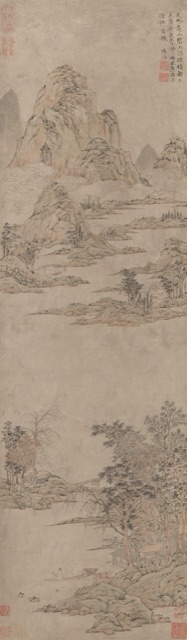
Pulling Oars under Clearing Autumn Skies 晴秋涉櫂圖
 Yuan dynasty (1279–1368), dated 1361
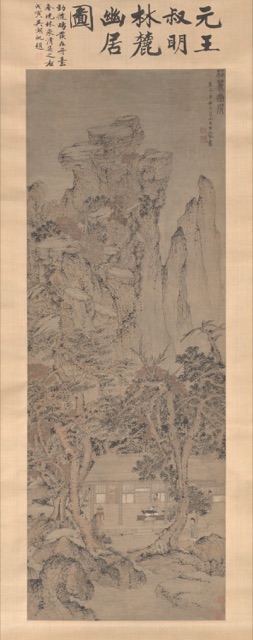
Quiet Life in a Wooded Glen 林麓幽居圖
 Ming dynasty (1368–1644), first half of 17th century
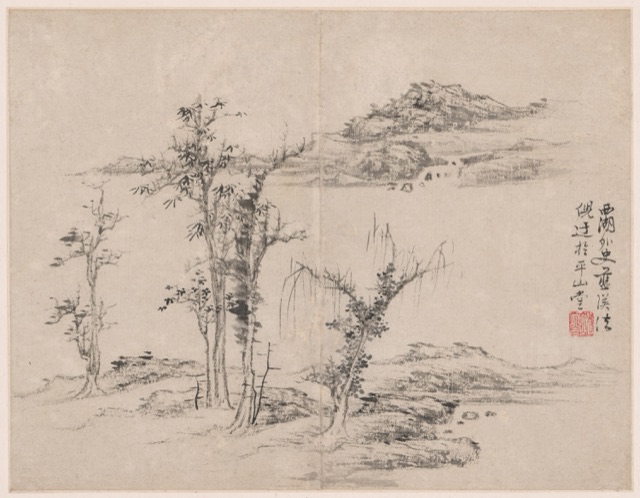
Landscape in the Style of Ancient Masters: after Ni Zan
 Ming dynasty (1368–1644), first half of 17th century