Quiet Life in a Wooded Glen 林麓幽居圖
Stop 1 · First look
First Look
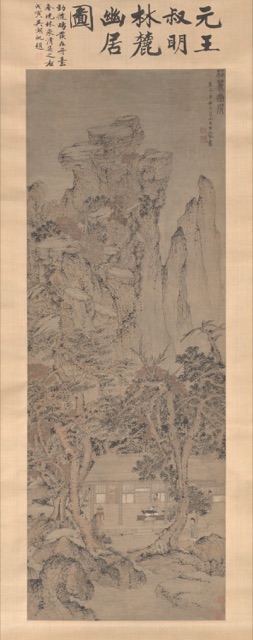
Look at the open-fronted cottage near the bottom of the scroll. A man is kneeling inside with a zither on the table in front of him, and servants wait nearby. Everything above him is mountain: rock piled on rock, with twisted pines growing out of the seams. Wang Meng painted this in thirteen sixty-one. It is a picture of a scholar who has left the world of office and gone to live among the hills.
Stop 2 · Technique
Closer Reading
Come close to any of the rocks. They are built from thousands of short, dry strokes and dots, laid over one another until the surface seems to move. That restless brushwork is Wang Meng’s own. He was the youngest of the painters later called the Four Great Masters of the Yuan dynasty, the period when the Mongols ruled China. Many educated men then stayed out of government, and they made painting a way of speaking about themselves. Wang Meng had served as a legal clerk, and in the unsettled last years of Mongol rule he withdrew to a mountain retreat. The Art Institute suggests that this scroll may be a kind of self-portrait. He wrote the title and the date at the upper right of the painting. The large characters across the top, above the picture, were added by a later hand.
Stop 3 · Museum record
Catalog Summary
A scholar plays the zither in a cottage at the foot of towering, crowded mountains. Wang Meng, one of the Four Great Masters of the Yuan dynasty, painted it in 1361. Hanging scroll, ink and light colours on paper; the painting is 177.8 × 64.2 cm and is shown with its title panel and mount.
Recorded physical scale: 81.6 × 206.6 cm (32.1 × 81.3 in · 0.82 × 2.07 m).
Stop 4 · Historical Context
Wang Meng (c. 1308–1385)
Last of the Four Masters of the Yuan dynasty, whose dense, restless mountain landscapes of scholars in retreat became models for later Chinese painters.
Chinese literati painting (Yuan to Qing dynasties, late 13th to early 20th century): The Chinese tradition of scholar-amateur painting, which valued personal brushwork, poetry and the study of old masters above lifelike description.
First Look
Look at the open-fronted cottage near the bottom of the scroll. A man is kneeling inside with a zither on the table in front of him, and servants wait nearby. Everything above him is mountain: rock piled on rock, with twisted pines growing out of the seams. Wang Meng painted this in thirteen sixty-one. It is a picture of a scholar who has left the world of office and gone to live among the hills.
Closer Reading
Come close to any of the rocks. They are built from thousands of short, dry strokes and dots, laid over one another until the surface seems to move. That restless brushwork is Wang Meng’s own. He was the youngest of the painters later called the Four Great Masters of the Yuan dynasty, the period when the Mongols ruled China. Many educated men then stayed out of government, and they made painting a way of speaking about themselves. Wang Meng had served as a legal clerk, and in the unsettled last years of Mongol rule he withdrew to a mountain retreat. The Art Institute suggests that this scroll may be a kind of self-portrait. He wrote the title and the date at the upper right of the painting. The large characters across the top, above the picture, were added by a later hand.
Catalog Summary
A scholar plays the zither in a cottage at the foot of towering, crowded mountains. Wang Meng, one of the Four Great Masters of the Yuan dynasty, painted it in 1361. Hanging scroll, ink and light colours on paper; the painting is 177.8 × 64.2 cm and is shown with its title panel and mount.
About the Artist
Wang Meng (c. 1308–1385)
Wang Meng was born around 1308 into a distinguished family in Wuxing, now Huzhou, in Zhejiang province. His mother's father was Zhao Mengfu, a leading painter of the early Yuan dynasty, when the Mongols ruled China. Wang Meng is counted as the last of the Four Masters of the Yuan, the scholar-painters who shaped literati landscape painting.
He served the Mongol government as a legal scribe. In the troubled last decades of Yuan rule he withdrew to the mountains north of Hangzhou and called himself the Woodcutter of Yellow Crane Mountain. His pictures are crowded and restless. Layered peaks and tangled trees fill the paper, and rocks are built from dry, fibrous strokes and dots. A favourite subject was the scholar's retreat: a small house below towering mountains, its owner reading or playing the zither.
Under the new Ming dynasty he held office again, was caught up in a purge and died in prison in 1385. Later painters kept returning to him: in 1701 Wang Yuanqi painted a landscape that follows his composition and brushwork.
Related works
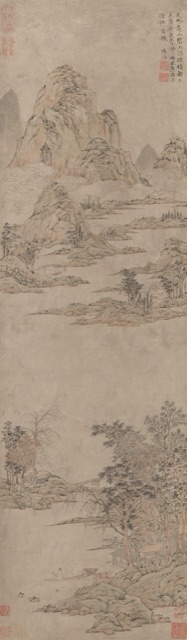 Ming dynasty (1368–1644); c. 1545
Pulling Oars under Clearing Autumn Skies 晴秋涉櫂圖
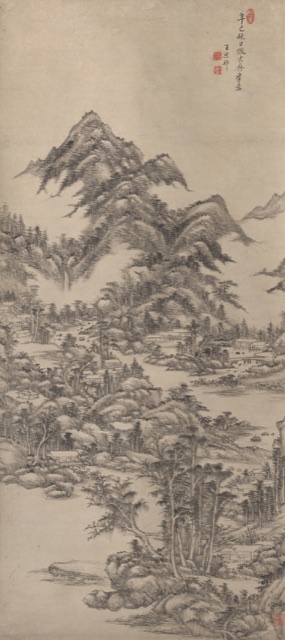 Qing Dynasty (1644–1911); dated 1701
Landscape after Huang Gongwang
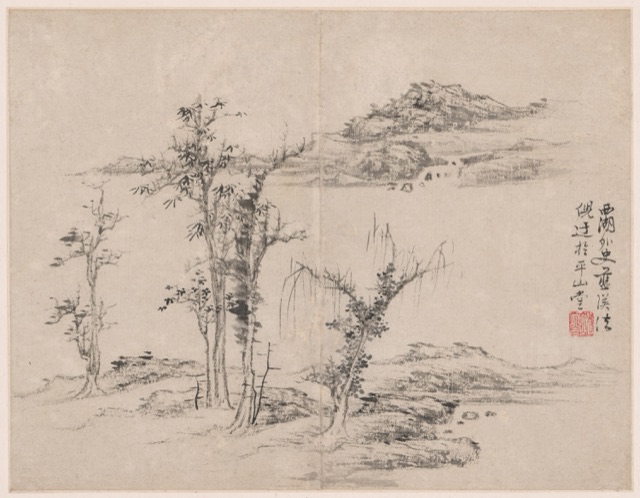 Ming dynasty (1368–1644), first half of 17th century
Landscape in the Style of Ancient Masters: after Ni Zan
 Ming dynasty (1368–1644), first half of 17th century