Stag at Sharkey's
Stop 1 · First look
First Look
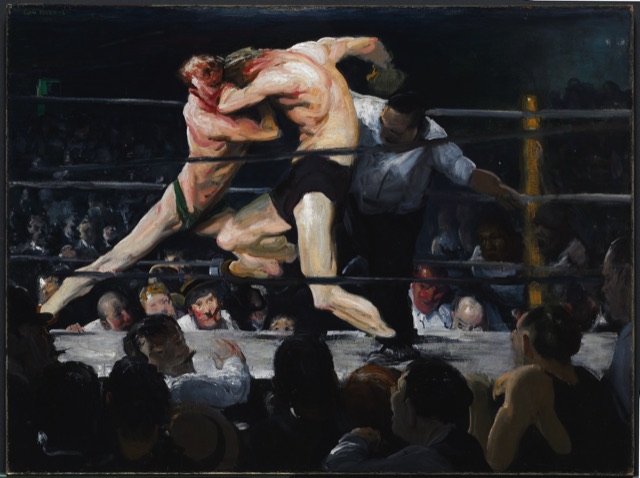
Look at the two fighters, and try to find where one body ends and the other begins. George Bellows painted them in nineteen oh nine with long, fast strokes, as if the paint itself had been thrown. This is Sharkey’s Athletic Club in New York, a saloon with a boxing ring in its back room. Around the ropes, the faces of the crowd look up out of the dark.
Stop 2 · Technique
Closer Reading
Now look at the faces along the edge of the ring. Each is painted in a few strokes: flushed, grinning, shouting. Public boxing was against the law in New York at the time, so a bout had to be arranged as a private event for the members of a club. When an outsider fought, he was given a temporary membership and called a stag, which is where the painting gets its name. The club belonged to Tom Sharkey, a former fighter who had served in the navy, and it stood near Bellows’s studio. Boxing divided opinion. Some people thought it barbaric. Others, President Theodore Roosevelt among them, admired it as healthy and manly. Bellows takes no side. He puts us a few rows back, behind the dark heads of other spectators, and lets us watch. The referee leans in from the right. Nobody in the room is looking anywhere else.
Stop 3 · Museum record
Catalog Summary
Two boxers lock together under the lights of Sharkey’s Athletic Club, a New York saloon with a ring in its back room, near Bellows’s studio. Public boxing was illegal in the city, so bouts were held as private club events, and an outsider who fought was made a temporary member and called a stag. Oil on canvas, 92 × 122.6 cm.
Recorded physical scale: 122.6 × 92.0 cm (48.3 × 36.2 in · 1.23 × 0.92 m).
Stop 4 · Historical Context
George Bellows (1882–1925)
American painter and printmaker of New York city life, best known for his pictures of prizefights.
Ashcan School (early 1900s): A group of painters in New York in the early 1900s, led by Robert Henri, who painted the ordinary life of the city's streets.
First Look
Look at the two fighters, and try to find where one body ends and the other begins. George Bellows painted them in nineteen oh nine with long, fast strokes, as if the paint itself had been thrown. This is Sharkey’s Athletic Club in New York, a saloon with a boxing ring in its back room. Around the ropes, the faces of the crowd look up out of the dark.
Closer Reading
Now look at the faces along the edge of the ring. Each is painted in a few strokes: flushed, grinning, shouting. Public boxing was against the law in New York at the time, so a bout had to be arranged as a private event for the members of a club. When an outsider fought, he was given a temporary membership and called a stag, which is where the painting gets its name. The club belonged to Tom Sharkey, a former fighter who had served in the navy, and it stood near Bellows’s studio. Boxing divided opinion. Some people thought it barbaric. Others, President Theodore Roosevelt among them, admired it as healthy and manly. Bellows takes no side. He puts us a few rows back, behind the dark heads of other spectators, and lets us watch. The referee leans in from the right. Nobody in the room is looking anywhere else.
Catalog Summary
Two boxers lock together under the lights of Sharkey’s Athletic Club, a New York saloon with a ring in its back room, near Bellows’s studio. Public boxing was illegal in the city, so bouts were held as private club events, and an outsider who fought was made a temporary member and called a stag. Oil on canvas, 92 × 122.6 cm.
About the Artist
George Bellows (1882–1925)
George Bellows was born and raised in Columbus, Ohio. At Ohio State University he played baseball and basketball and drew for the student publications. Against his parents' wishes he left in 1904 for New York, to study at the New York School of Art.
There he became a follower of Robert Henri, who taught that art should deal with real life. Henri led a group of painters, later called the Ashcan School, who found their subjects in the streets and docks of the growing city. Bellows was not one of its eight members, but he painted the same things, and from 1907 New York was his main subject. He is best known for his boxing pictures, painted in broad strokes. Public prizefights were illegal in the city, so bouts were held in private clubs such as Sharkey's, near his studio.
He helped to organise the Armory Show of 1913, which brought modern French painting before the American public. He also made lithographs, among them a series on the First World War in 1918. Bellows died in New York in 1925, aged 42, after his appendix burst.