Apollo 11 Command Module Columbia
Stop 1 · First look
First Look
Look at the wide base of the cone, where the surface is darkest. That is the heat shield, and it is burned. This is Columbia, the command module of Apollo eleven. In July nineteen sixty-nine three men lived inside it for eight days, on the way to the Moon and back. It is the only part of their spacecraft that returned to Earth. Walk around it, and notice how small it is.
Stop 2 · Technique
Closer Reading
Find the hatch on the side of the cone, and imagine three couches behind it, side by side. The cabin had about as much room as the inside of a large car. Neil Armstrong and Buzz Aldrin left it for a day to land on the Moon in a separate craft, while Michael Collins stayed behind and circled alone, out of radio contact each time he passed behind the far side. When the three came home, Columbia met the atmosphere at about eleven kilometres a second. The shield on its base was made to char and flake away, carrying the heat with it, and what you see is what was left. It came down under parachutes in the Pacific Ocean on the twenty-fourth of July. The Smithsonian has scanned the whole surface, so every scorch mark and panel line here is in its true place.
Stop 3 · Museum record
Catalog Summary
The only part of the Apollo 11 spacecraft to come home. In July 1969 this cabin carried Neil Armstrong, Buzz Aldrin and Michael Collins to the Moon and back, and its base still shows the burn of re-entry. Aluminium alloy, stainless steel and titanium structure with an ablative heat shield; 3.9 m across. Shown at full size from the Smithsonian's scan.
Recorded physical scale: 390.5 × 274.1 cm (153.7 × 107.9 in · 3.90 × 2.74 m).
Stop 4 · Historical Context
Rockwell International
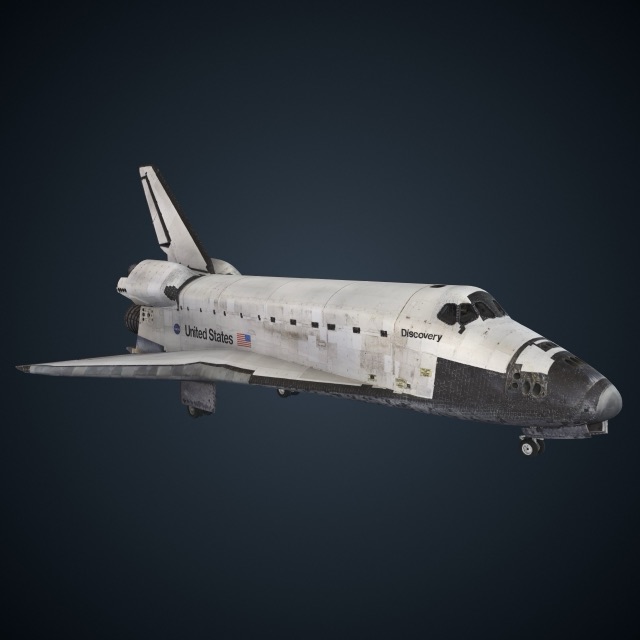
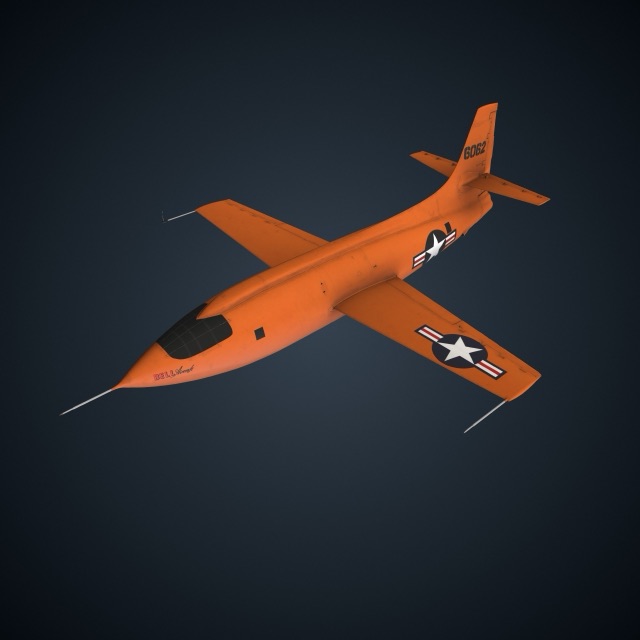
American aerospace company that built the Apollo 11 command module as North American Rockwell and the space shuttle Discovery as Rockwell International.
Flight and space: Aircraft and spacecraft, kept for where they went and for what they were the first to do.
First Look
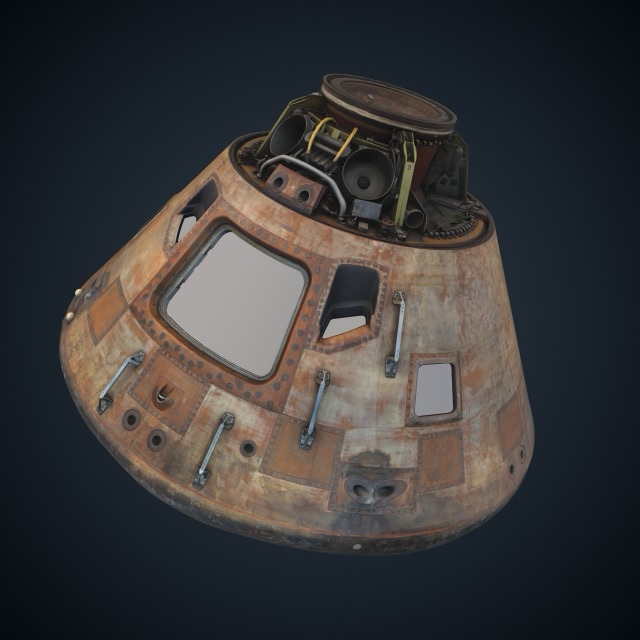
Look at the wide base of the cone, where the surface is darkest. That is the heat shield, and it is burned. This is Columbia, the command module of Apollo eleven. In July nineteen sixty-nine three men lived inside it for eight days, on the way to the Moon and back. It is the only part of their spacecraft that returned to Earth. Walk around it, and notice how small it is.
Closer Reading
Find the hatch on the side of the cone, and imagine three couches behind it, side by side. The cabin had about as much room as the inside of a large car. Neil Armstrong and Buzz Aldrin left it for a day to land on the Moon in a separate craft, while Michael Collins stayed behind and circled alone, out of radio contact each time he passed behind the far side. When the three came home, Columbia met the atmosphere at about eleven kilometres a second. The shield on its base was made to char and flake away, carrying the heat with it, and what you see is what was left. It came down under parachutes in the Pacific Ocean on the twenty-fourth of July. The Smithsonian has scanned the whole surface, so every scorch mark and panel line here is in its true place.
Catalog Summary
The only part of the Apollo 11 spacecraft to come home. In July 1969 this cabin carried Neil Armstrong, Buzz Aldrin and Michael Collins to the Moon and back, and its base still shows the burn of re-entry. Aluminium alloy, stainless steel and titanium structure with an ablative heat shield; 3.9 m across. Shown at full size from the Smithsonian's scan.
About the Artist
Rockwell International
North American Rockwell was formed from two older companies: North American Aviation, the maker of the X-15 rocket plane, and Rockwell-Standard. It later took the name Rockwell International.
The Smithsonian records North American Rockwell as the maker of Columbia, the Apollo 11 command module, which carried Neil Armstrong, Buzz Aldrin and Michael Collins to the Moon and back in July 1969.
As Rockwell International the company built the space shuttle orbiter Discovery, which entered service in 1984 and flew 39 missions, more than any other orbiter. In July 2001 Rockwell International changed its name to Rockwell Automation.