Bell X-1 Glamorous Glennis
Stop 1 · First look
First Look
Look at the nose, and follow the line of the body back to the tail. The shape was copied from a machine-gun bullet, which was one of the few things known to fly smoothly faster than sound. On the fourteenth of October nineteen forty-seven, this aircraft became the first to do the same with a pilot inside. He was Captain Charles Yeager, and he named it Glamorous Glennis, after his wife.
Stop 2 · Technique
Closer Reading
Notice the wings. They are short, straight and very thin, built to stay rigid in air that behaves almost like a solid near the speed of sound. There is no propeller and no jet intake. The aircraft burned alcohol and liquid oxygen in a rocket engine with four chambers, enough for only a few minutes of power. So it did not take off from the ground. A bomber carried it up under its belly to about seven thousand metres and dropped it, and the pilot lit the rocket and climbed. On that October flight Yeager reached Mach one point oh six at forty-three thousand feet. The National Air and Space Museum records that this aircraft flew seventy-eight times in all. In August nineteen fifty the Air Force presented it to the Smithsonian.
Stop 3 · Museum record
Catalog Summary
On 14 October 1947 this rocket plane, flown by Captain Charles Yeager, became the first aircraft to fly faster than sound. It was carried aloft under a bomber and released, and its orange paint was chosen to be seen. Aluminium; 9.4 m long with an 8.5 m wingspan. Shown at full size from the Smithsonian's scan.
Recorded physical scale: 857.6 × 319.7 cm (337.6 × 125.9 in · 8.58 × 3.20 m).
Stop 4 · Historical Context
Bell Aircraft Corporation
American aircraft maker of Buffalo, New York, that built the rocket-powered X-1, the first aircraft flown faster than sound.
Flight and space: Aircraft and spacecraft, kept for where they went and for what they were the first to do.
First Look
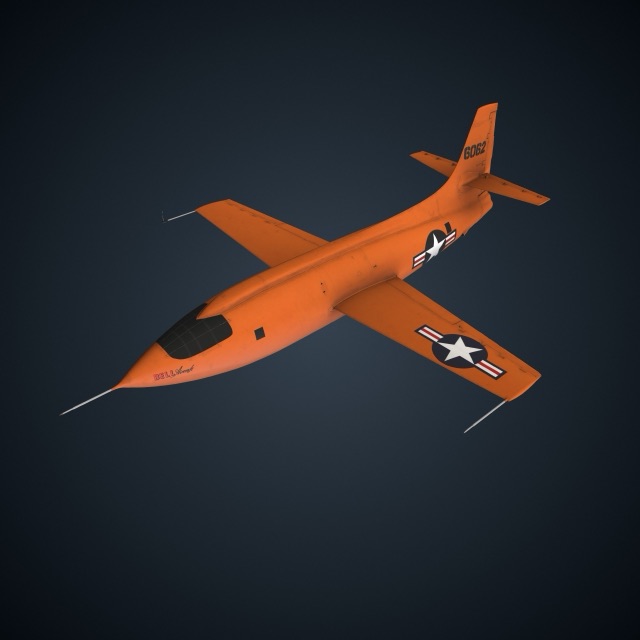
Look at the nose, and follow the line of the body back to the tail. The shape was copied from a machine-gun bullet, which was one of the few things known to fly smoothly faster than sound. On the fourteenth of October nineteen forty-seven, this aircraft became the first to do the same with a pilot inside. He was Captain Charles Yeager, and he named it Glamorous Glennis, after his wife.
Closer Reading
Notice the wings. They are short, straight and very thin, built to stay rigid in air that behaves almost like a solid near the speed of sound. There is no propeller and no jet intake. The aircraft burned alcohol and liquid oxygen in a rocket engine with four chambers, enough for only a few minutes of power. So it did not take off from the ground. A bomber carried it up under its belly to about seven thousand metres and dropped it, and the pilot lit the rocket and climbed. On that October flight Yeager reached Mach one point oh six at forty-three thousand feet. The National Air and Space Museum records that this aircraft flew seventy-eight times in all. In August nineteen fifty the Air Force presented it to the Smithsonian.
Catalog Summary
On 14 October 1947 this rocket plane, flown by Captain Charles Yeager, became the first aircraft to fly faster than sound. It was carried aloft under a bomber and released, and its orange paint was chosen to be seen. Aluminium; 9.4 m long with an 8.5 m wingspan. Shown at full size from the Smithsonian's scan.
About the Artist
Bell Aircraft Corporation
The Bell Aircraft Corporation of Buffalo, New York, was founded in July 1935.
In March 1945 the United States Army gave Bell a contract to develop three research aircraft for flight near and beyond the speed of sound. Bell built three rocket-powered aircraft, called the XS-1 and later the X-1. On 14 October 1947 Captain Charles Yeager, flying the first of them, became the first pilot to fly faster than sound.
Lawrence Bell, whose name the company bore, is credited with developing and producing the first helicopter licensed for commercial use, in 1946.