1946–1984 · 3 works · National Air and Space Museum, Smithsonian
Air and Space: Three Machines
Stop 1 of 3 · Bell Aircraft Corp. · 1946
Bell X-1 Glamorous Glennis
First Look
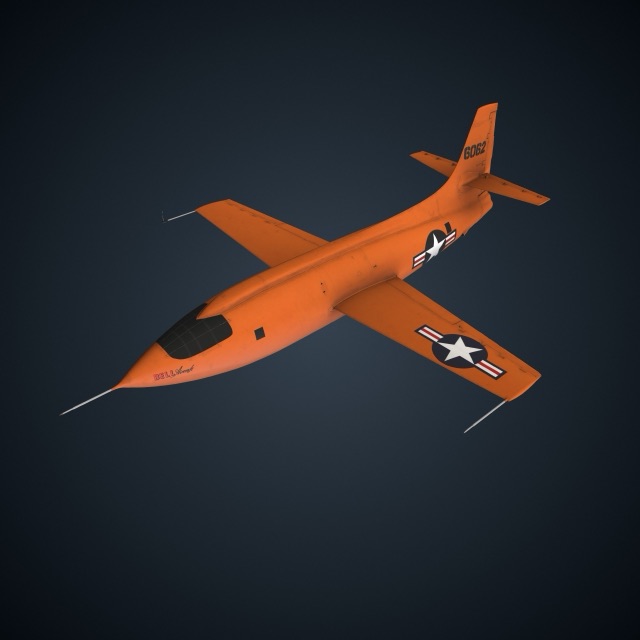
Look at the nose, and follow the line of the body back to the tail. The shape was copied from a machine-gun bullet, which was one of the few things known to fly smoothly faster than sound. On the fourteenth of October nineteen forty-seven, this aircraft became the first to do the same with a pilot inside. He was Captain Charles Yeager, and he named it Glamorous Glennis, after his wife.
A closer look
Notice the wings. They are short, straight and very thin, built to stay rigid in air that behaves almost like a solid near the speed of sound. There is no propeller and no jet intake. The aircraft burned alcohol and liquid oxygen in a rocket engine with four chambers, enough for only a few minutes of power. So it did not take off from the ground. A bomber carried it up under its belly to about seven thousand metres and dropped it, and the pilot lit the rocket and climbed. On that October flight Yeager reached Mach one point oh six at forty-three thousand feet. The National Air and Space Museum records that this aircraft flew seventy-eight times in all. In August nineteen fifty the Air Force presented it to the Smithsonian.
On 14 October 1947 this rocket plane, flown by Captain Charles Yeager, became the first aircraft to fly faster than sound. It was carried aloft under a bomber and released, and its orange paint was chosen to be seen. Aluminium; 9.4 m long with an 8.5 m wingspan. Shown at full size from the Smithsonian's scan.
Stop 2 of 3 · North American Rockwell · 1969
Apollo 11 Command Module Columbia
First Look
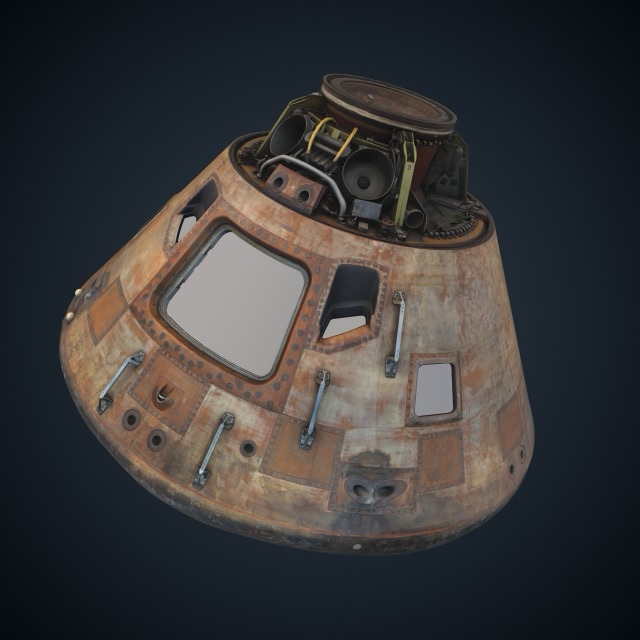
Look at the wide base of the cone, where the surface is darkest. That is the heat shield, and it is burned. This is Columbia, the command module of Apollo eleven. In July nineteen sixty-nine three men lived inside it for eight days, on the way to the Moon and back. It is the only part of their spacecraft that returned to Earth. Walk around it, and notice how small it is.
A closer look
Find the hatch on the side of the cone, and imagine three couches behind it, side by side. The cabin had about as much room as the inside of a large car. Neil Armstrong and Buzz Aldrin left it for a day to land on the Moon in a separate craft, while Michael Collins stayed behind and circled alone, out of radio contact each time he passed behind the far side. When the three came home, Columbia met the atmosphere at about eleven kilometres a second. The shield on its base was made to char and flake away, carrying the heat with it, and what you see is what was left. It came down under parachutes in the Pacific Ocean on the twenty-fourth of July. The Smithsonian has scanned the whole surface, so every scorch mark and panel line here is in its true place.
The only part of the Apollo 11 spacecraft to come home. In July 1969 this cabin carried Neil Armstrong, Buzz Aldrin and Michael Collins to the Moon and back, and its base still shows the burn of re-entry. Aluminium alloy, stainless steel and titanium structure with an ablative heat shield; 3.9 m across. Shown at full size from the Smithsonian's scan.
Stop 3 of 3 · Rockwell International Corporation · Flown 1984 to 2011
Space Shuttle Discovery
First Look
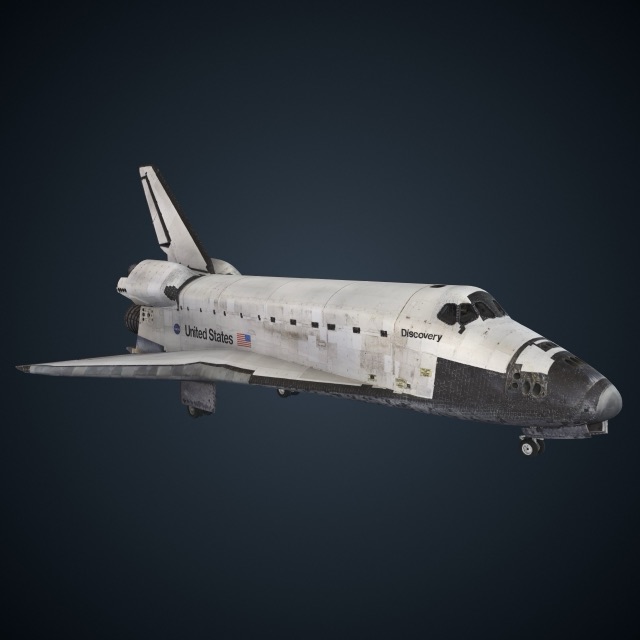
Look at the underside and the nose, where the surface turns black. Those are heat tiles, thousands of them, each cut to fit its own place. This is the space shuttle Discovery, shown at one tenth of its real size. The real orbiter is nearly thirty-eight metres long. It flew thirty-nine times between nineteen eighty-four and two thousand eleven, more than any other shuttle.
A closer look
Walk to the back and look at the three large engine bells, with two smaller ones above them. The large engines burned for only eight and a half minutes on the way up, fed from an external tank that was then thrown away. Everything you see here came back, landed on a runway like a glider, and flew again. That was the idea of the shuttle: a spacecraft used many times. In nineteen ninety Discovery carried the Hubble Space Telescope into orbit in the long bay behind the cabin. It was also the orbiter chosen to return to flight after each of the two shuttle accidents, in nineteen eighty-eight and in two thousand five. Remember the scale as you look. At full size the tail of this craft would stand about as high as a five-storey building.
Discovery flew thirty-nine missions between 1984 and 2011, more than any other orbiter, and carried the Hubble Space Telescope into orbit. The real spacecraft is about 38 m long with a 24 m wingspan. It is shown here at one tenth of its size, from the Smithsonian's scan of the whole exterior.
1946Bell X-1 Glamorous Glennis
On 14 October 1947 this rocket plane, flown by Captain Charles Yeager, became the first aircraft to fly faster than sound. It was carried aloft under a bomber and released, and its orange paint was chosen to be seen. Aluminium; 9.4 m long with an 8.5 m wingspan. Shown at full size from the Smithsonian's scan.
1969Apollo 11 Command Module Columbia
The only part of the Apollo 11 spacecraft to come home. In July 1969 this cabin carried Neil Armstrong, Buzz Aldrin and Michael Collins to the Moon and back, and its base still shows the burn of re-entry. Aluminium alloy, stainless steel and titanium structure with an ablative heat shield; 3.9 m across. Shown at full size from the Smithsonian's scan.
Flown 1984 to 2011Space Shuttle Discovery
Discovery flew thirty-nine missions between 1984 and 2011, more than any other orbiter, and carried the Hubble Space Telescope into orbit. The real spacecraft is about 38 m long with a 24 m wingspan. It is shown here at one tenth of its size, from the Smithsonian's scan of the whole exterior.
Other exhibitions
The Sistine Chapel: Ceiling, Altar, and Wall Cycles
Michelangelo’s ceiling and Last Judgment alongside the fifteenth-century north and south wall narratives by Botticelli, Perugino, Ghirlandaio, Rosselli, and Signorelli.
1765–1857 · 7 worksEdo: Pictures of the Floating World
Seven woodblock prints from the city of Edo, 1765 to 1857: Harunobu, Kiyonaga, Sharaku, Utamaro and Hiroshige, from the Art Institute of Chicago.
1867–1893 · 7 worksImpressionism: Painters of Modern Life
Seven painters and seven views of modern France, 1867 to 1893: Monet, Renoir, Morisot, Caillebotte, Degas, Cassatt and Pissarro, from the Art Institute of Chicago.
1782–1893 · 6 worksFrom Edo to Paris: Ukiyo-e and the Impressionist Eye
How Japanese woodblock masters Hiroshige and Kiyonaga inspired the cropped framing, asymmetric diagonals, and rain-swept streets of Caillebotte, Degas, and Cassatt.