Space Shuttle Discovery
Stop 1 · First look
First Look
Look at the underside and the nose, where the surface turns black. Those are heat tiles, thousands of them, each cut to fit its own place. This is the space shuttle Discovery, shown at one tenth of its real size. The real orbiter is nearly thirty-eight metres long. It flew thirty-nine times between nineteen eighty-four and two thousand eleven, more than any other shuttle.
Stop 2 · Technique
Closer Reading
Walk to the back and look at the three large engine bells, with two smaller ones above them. The large engines burned for only eight and a half minutes on the way up, fed from an external tank that was then thrown away. Everything you see here came back, landed on a runway like a glider, and flew again. That was the idea of the shuttle: a spacecraft used many times. In nineteen ninety Discovery carried the Hubble Space Telescope into orbit in the long bay behind the cabin. It was also the orbiter chosen to return to flight after each of the two shuttle accidents, in nineteen eighty-eight and in two thousand five. Remember the scale as you look. At full size the tail of this craft would stand about as high as a five-storey building.
Stop 3 · Museum record
Catalog Summary
Discovery flew thirty-nine missions between 1984 and 2011, more than any other orbiter, and carried the Hubble Space Telescope into orbit. The real spacecraft is about 38 m long with a 24 m wingspan. It is shown here at one tenth of its size, from the Smithsonian's scan of the whole exterior.
Recorded physical scale: 2381.4 × 1582.9 cm (937.6 × 623.2 in · 23.81 × 15.83 m).
Stop 4 · Historical Context
Rockwell International
American aerospace company that built the Apollo 11 command module as North American Rockwell and the space shuttle Discovery as Rockwell International.
Flight and space: Aircraft and spacecraft, kept for where they went and for what they were the first to do.
First Look
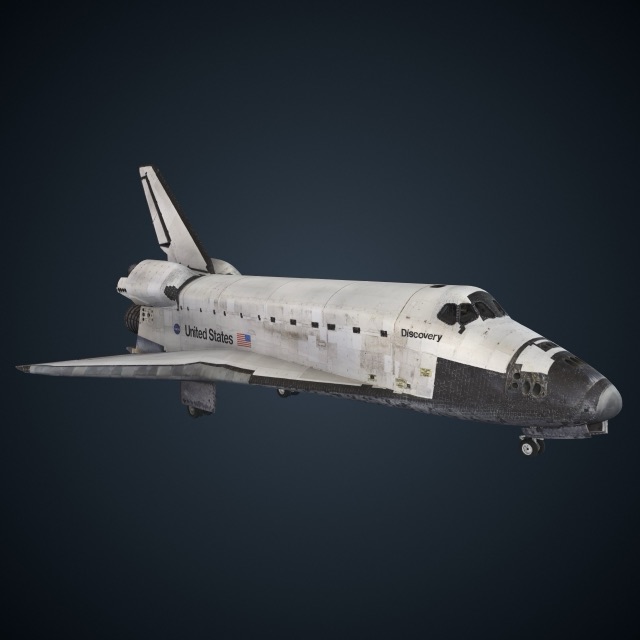
Look at the underside and the nose, where the surface turns black. Those are heat tiles, thousands of them, each cut to fit its own place. This is the space shuttle Discovery, shown at one tenth of its real size. The real orbiter is nearly thirty-eight metres long. It flew thirty-nine times between nineteen eighty-four and two thousand eleven, more than any other shuttle.
Closer Reading
Walk to the back and look at the three large engine bells, with two smaller ones above them. The large engines burned for only eight and a half minutes on the way up, fed from an external tank that was then thrown away. Everything you see here came back, landed on a runway like a glider, and flew again. That was the idea of the shuttle: a spacecraft used many times. In nineteen ninety Discovery carried the Hubble Space Telescope into orbit in the long bay behind the cabin. It was also the orbiter chosen to return to flight after each of the two shuttle accidents, in nineteen eighty-eight and in two thousand five. Remember the scale as you look. At full size the tail of this craft would stand about as high as a five-storey building.
Catalog Summary
Discovery flew thirty-nine missions between 1984 and 2011, more than any other orbiter, and carried the Hubble Space Telescope into orbit. The real spacecraft is about 38 m long with a 24 m wingspan. It is shown here at one tenth of its size, from the Smithsonian's scan of the whole exterior.
About the Artist
Rockwell International
North American Rockwell was formed from two older companies: North American Aviation, the maker of the X-15 rocket plane, and Rockwell-Standard. It later took the name Rockwell International.
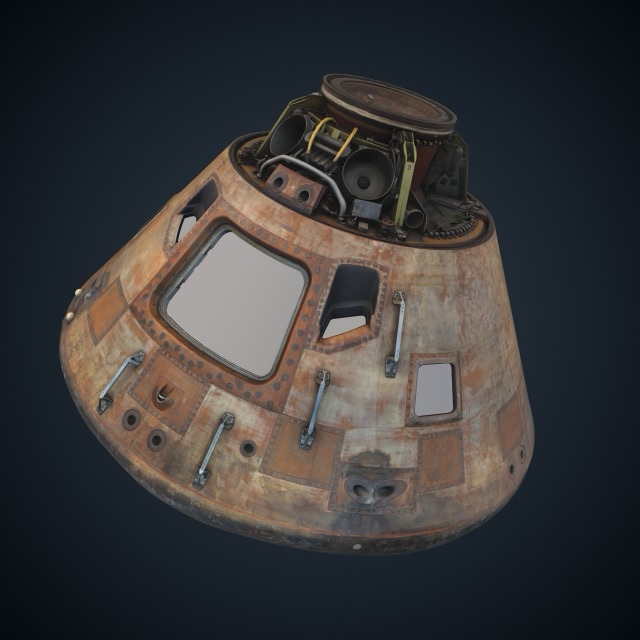
The Smithsonian records North American Rockwell as the maker of Columbia, the Apollo 11 command module, which carried Neil Armstrong, Buzz Aldrin and Michael Collins to the Moon and back in July 1969.
As Rockwell International the company built the space shuttle orbiter Discovery, which entered service in 1984 and flew 39 missions, more than any other orbiter. In July 2001 Rockwell International changed its name to Rockwell Automation.