Portrait of a Young Man
Stop 1 · First look
First Look
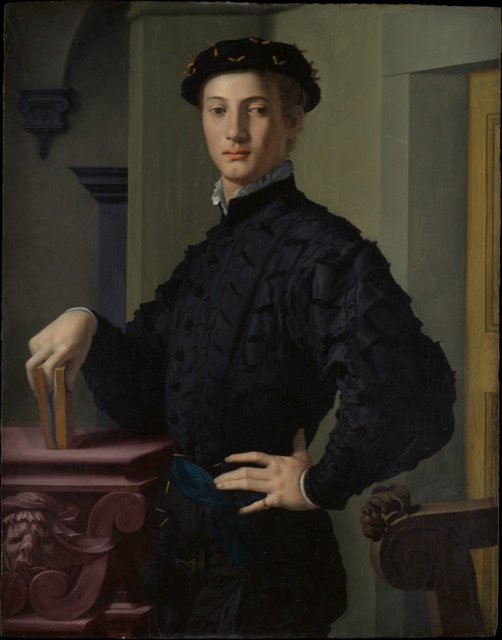
Look at the carved face on the table, under the young man’s book, and then find the second one on the arm of the chair. Both are grimacing. Above them the sitter keeps a perfectly composed expression, one hand on his hip and the other holding his place in a book. Bronzino painted him in Florence in the fifteen thirties. Nobody knows his name.
Stop 2 · Technique
Closer Reading
Notice the young man’s eyes. One looks at us and the other drifts very slightly outward, and Bronzino has recorded that without correcting it. Everything else is control: the black satin slashed in rows, the long fingers, the cool grey architecture. The sitter was probably one of the painter’s literary friends. Bronzino wrote poetry himself, and the book is a sign of that shared world. The carved masks on the furniture may be a private joke about faces and disguises, set beside a face that gives nothing away. Examination of the panel has shown that Bronzino changed his mind as he worked, altering the architecture behind the figure. He went on to become court painter to the Medici dukes, and his portraits set the pattern for how the rulers of Florence wished to be seen.
Stop 3 · Museum record
Catalog Summary
An unnamed young Florentine, book in hand, poses with studied ease between a table and a chair carved with grotesque faces. Bronzino later became court painter to the Medici dukes. Oil on wood, 95.6 × 74.9 cm.
Recorded physical scale: 74.9 × 95.6 cm (29.5 × 37.6 in · 0.75 × 0.96 m).
Stop 4 · Historical Context
Bronzino (1503–1572)
Court painter to Duke Cosimo I de' Medici, whose refined, polished style dominated painting in Florence from the 1530s to the 1560s.
Mannerism (about 1520 to 1600): A cool, elegant and deliberately artificial style that followed the High Renaissance in Italy from about 1520 and spread to courts and cities across Europe.
First Look
Look at the carved face on the table, under the young man’s book, and then find the second one on the arm of the chair. Both are grimacing. Above them the sitter keeps a perfectly composed expression, one hand on his hip and the other holding his place in a book. Bronzino painted him in Florence in the fifteen thirties. Nobody knows his name.
Closer Reading
Notice the young man’s eyes. One looks at us and the other drifts very slightly outward, and Bronzino has recorded that without correcting it. Everything else is control: the black satin slashed in rows, the long fingers, the cool grey architecture. The sitter was probably one of the painter’s literary friends. Bronzino wrote poetry himself, and the book is a sign of that shared world. The carved masks on the furniture may be a private joke about faces and disguises, set beside a face that gives nothing away. Examination of the panel has shown that Bronzino changed his mind as he worked, altering the architecture behind the figure. He went on to become court painter to the Medici dukes, and his portraits set the pattern for how the rulers of Florence wished to be seen.
Catalog Summary
An unnamed young Florentine, book in hand, poses with studied ease between a table and a chair carved with grotesque faces. Bronzino later became court painter to the Medici dukes. Oil on wood, 95.6 × 74.9 cm.
About the Artist
Bronzino (1503–1572)
Agnolo di Cosimo, called Bronzino, was born in 1503 at Monticelli, near Florence. Nobody knows where the nickname came from. He trained first with Raffaellino del Garbo and then with Jacopo Pontormo, who became his friend for life. The two worked together on frescoes in the church of Santa Felicita. Like many painters of his generation he also learned from the work of Michelangelo.
In 1539 he worked on the decorations for the wedding of Duke Cosimo I de' Medici and Eleonora of Toledo, and was made court painter. He painted the duke, the duchess, their children and their courtiers. What counts in these portraits is rank, an elegant pose and self-control. Rich cloth, jewels and gleaming armour speak of wealth and power. He is classed as a Mannerist, one of the painters who prized refined and stylish artifice.
Bronzino also painted religious and mythological subjects and wrote poetry. In 1563 he helped to found the Accademia del Disegno, Florence's academy of drawing. His pupil Alessandro Allori was his chief follower. He died in Florence in 1572.