Hermann von Wedigh III (died 1560)
Stop 1 · First look
First Look
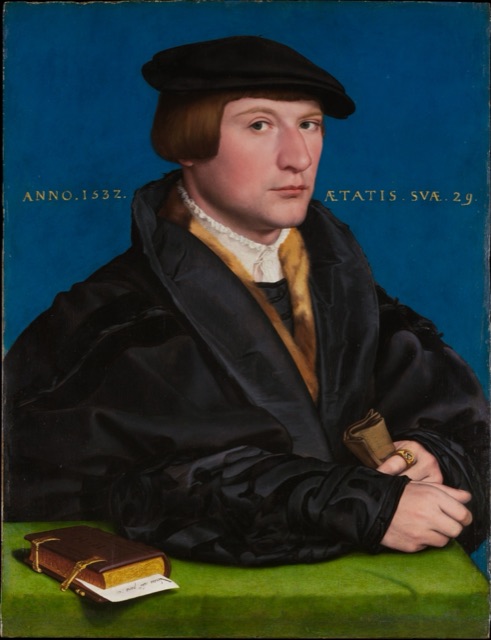
Look at the slip of paper tucked into the book on the table. A few words of Latin are written on it, small enough to make you lean in. Hans Holbein painted this merchant in London in fifteen thirty-two. The gold letters on either side of his head give the year and the sitter’s age, twenty-nine. He came from Cologne, and his look is level and unhurried.
Stop 2 · Technique
Closer Reading
Notice the blue behind the sitter. It is flat, with no room and no shadow, so the fur, the black satin and the face stand out like objects laid on a cloth. Holbein had come to London from Basel, and his first steady clients there were German merchants of the Hanseatic League, who lived and traded together in a walled compound by the Thames called the Steelyard. Hermann von Wedigh belonged to a Cologne family in that trade. On his finger is a ring with his family’s arms, and his shortened name is written on the edge of the book. The Latin on the slip of paper is a line from the Roman playwright Terence: truth breeds hatred. Why he chose it is not recorded. Within a few years Holbein was painting the king, Henry the Eighth, and his court.
Stop 3 · Museum record
Catalog Summary
A merchant from Cologne, twenty-nine years old, sits behind a green table in London, where German traders of the Hanseatic League kept their own trading house. The year and his age are lettered in gold across the blue ground. Oil and gold on oak, 42.2 × 32.4 cm.
Recorded physical scale: 32.4 × 42.2 cm (12.8 × 16.6 in · 0.32 × 0.42 m).
Stop 4 · Historical Context
Hans Holbein the Younger (c. 1497–1543)
German painter who settled in London and recorded merchants, scholars and the court of King Henry VIII in portraits of great exactness.
Northern Renaissance (about 1430 to 1600): The art of the Low Countries and the German lands in the 15th and 16th centuries, known for oil painting and close, exact observation of the visible world.
First Look
Look at the slip of paper tucked into the book on the table. A few words of Latin are written on it, small enough to make you lean in. Hans Holbein painted this merchant in London in fifteen thirty-two. The gold letters on either side of his head give the year and the sitter’s age, twenty-nine. He came from Cologne, and his look is level and unhurried.
Closer Reading
Notice the blue behind the sitter. It is flat, with no room and no shadow, so the fur, the black satin and the face stand out like objects laid on a cloth. Holbein had come to London from Basel, and his first steady clients there were German merchants of the Hanseatic League, who lived and traded together in a walled compound by the Thames called the Steelyard. Hermann von Wedigh belonged to a Cologne family in that trade. On his finger is a ring with his family’s arms, and his shortened name is written on the edge of the book. The Latin on the slip of paper is a line from the Roman playwright Terence: truth breeds hatred. Why he chose it is not recorded. Within a few years Holbein was painting the king, Henry the Eighth, and his court.
Catalog Summary
A merchant from Cologne, twenty-nine years old, sits behind a green table in London, where German traders of the Hanseatic League kept their own trading house. The year and his age are lettered in gold across the blue ground. Oil and gold on oak, 42.2 × 32.4 cm.
About the Artist
Hans Holbein the Younger (c. 1497–1543)
Hans Holbein was born in Augsburg, in Germany, in the winter of 1497 to 1498. His father, Hans Holbein the Elder, was a painter and taught him. He made his career in Basel, in Switzerland, where he joined the painters' guild in 1519, painted altarpieces and designed woodcuts.
The Reformation, the movement that split the western Church, left painters in Basel with few orders for religious pictures. In 1526 Holbein went to England with a letter from the scholar Erasmus to Thomas More, and stayed two years. In 1532 he went back and settled in London. He painted German merchants of the Hanseatic League, who lived in a London enclave called the Steelyard, and by 1536 he was court painter to King Henry VIII.
His preparatory drawings, in coloured chalks and ink on pink paper, set down a face with great precision. The paintings record fur, satin and jewels, and gold Latin lettering often gives the sitter's age and the year. He also designed jewellery and metalwork. Holbein died in London in 1543, probably of the plague.