Portrait of a Woman with a Man at a Casement
Stop 1 · First look
First Look
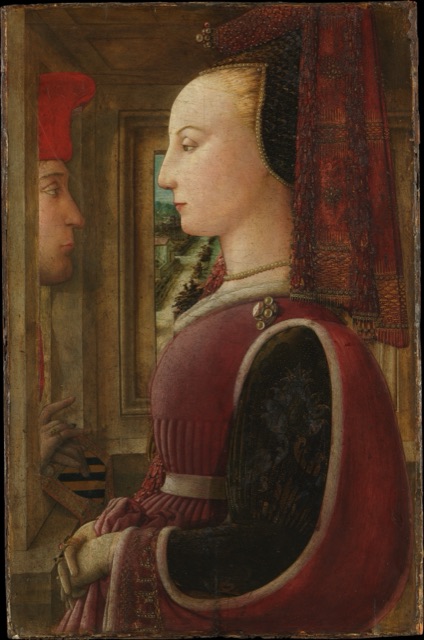
Look at the two profiles, and at the gap between them. The man at the window and the woman in the room face each other, but their eyes do not meet. Fra Filippo Lippi painted them in Florence around fourteen forty. Under the man’s hands is a coat of arms, which is how the family has been identified. It is the earliest double portrait to survive from Italy.
Stop 2 · Technique
Closer Reading
Notice how many spaces this small panel holds. There is the room the woman stands in, the window where the man appears, and a second window behind her that opens onto the country beyond. No Italian portrait before this one had placed its sitter in a room, or given a view onto a landscape. The strict profile comes from coins and medals, and was the usual choice for portraits in Florence at the time. The coat of arms belongs to the Scolari family, and the couple are thought to be Lorenzo Scolari and Angiola Sapiti, who married in the fourteen thirties. Look at the edge of her sleeve. Letters are stitched there in gold and pearls, spelling a word for loyalty. Lippi was a friar as well as a painter, and among his pupils was the young Botticelli.
Stop 3 · Museum record
Catalog Summary
A woman in profile stands in a small room while a man looks in at the window, his hands resting on a coat of arms. This is the earliest surviving double portrait in Italian painting, and the first to place its sitters indoors. Tempera on wood, 64.1 × 41.9 cm.
Recorded physical scale: 41.9 × 64.1 cm (16.5 × 25.2 in · 0.42 × 0.64 m).
Stop 4 · Historical Context
Fra Filippo Lippi (c. 1406–1469)
Florentine friar and painter of graceful Madonnas, backed by the Medici, in whose workshop the young Sandro Botticelli learned to paint.
Early Renaissance (15th century): The first age of the Renaissance in Italy, roughly the 15th century, when painters in Florence learned to give figures weight and to set them in a space that looks real.
First Look
Look at the two profiles, and at the gap between them. The man at the window and the woman in the room face each other, but their eyes do not meet. Fra Filippo Lippi painted them in Florence around fourteen forty. Under the man’s hands is a coat of arms, which is how the family has been identified. It is the earliest double portrait to survive from Italy.
Closer Reading
Notice how many spaces this small panel holds. There is the room the woman stands in, the window where the man appears, and a second window behind her that opens onto the country beyond. No Italian portrait before this one had placed its sitter in a room, or given a view onto a landscape. The strict profile comes from coins and medals, and was the usual choice for portraits in Florence at the time. The coat of arms belongs to the Scolari family, and the couple are thought to be Lorenzo Scolari and Angiola Sapiti, who married in the fourteen thirties. Look at the edge of her sleeve. Letters are stitched there in gold and pearls, spelling a word for loyalty. Lippi was a friar as well as a painter, and among his pupils was the young Botticelli.
Catalog Summary
A woman in profile stands in a small room while a man looks in at the window, his hands resting on a coat of arms. This is the earliest surviving double portrait in Italian painting, and the first to place its sitters indoors. Tempera on wood, 64.1 × 41.9 cm.
About the Artist
Fra Filippo Lippi (c. 1406–1469)
Filippo Lippi was born in Florence about 1406. He was an orphan and was sent to the Carmelite friary in the city, where he took his vows in 1421. Fra means brother, the title of a friar. The religious life did not suit him, and lawsuits, complaints and scandal followed him.
His paintings were popular in Florence, and the Medici family supported him. In his best-known work, a Virgin and Child with two angels, the Virgin is dressed like a Florentine noblewoman of the time, and a window behind her opens onto a wide landscape. About 1440 he painted a portrait of a woman with a man looking in at her window.
He spent long periods painting frescoes, pictures made on fresh wall plaster, in Prato and in Spoleto. In Prato in 1456 he abducted Lucrezia Buti, a nun from the convent where he was chaplain, and he was later allowed to marry her. Their son Filippino learned to paint in his father's workshop, and so did Sandro Botticelli. Lippi died in Spoleto in 1469.