1435–1532 · 5 works · The Metropolitan Museum of Art
Renaissance Faces: Five Portraits
Stop 1 of 5 · Fra Filippo Lippi · ca. 1440
Portrait of a Woman with a Man at a Casement
First Look
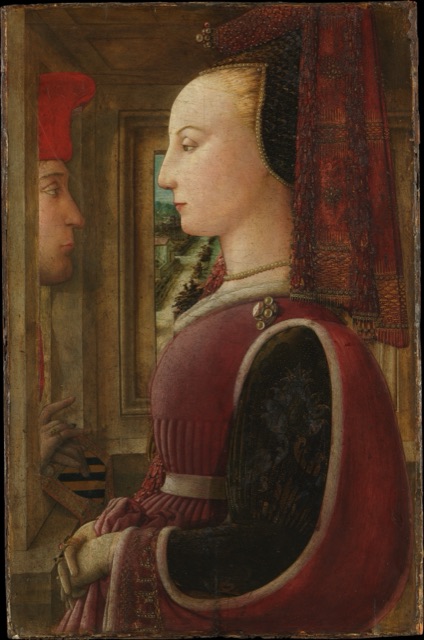
Look at the two profiles, and at the gap between them. The man at the window and the woman in the room face each other, but their eyes do not meet. Fra Filippo Lippi painted them in Florence around fourteen forty. Under the man’s hands is a coat of arms, which is how the family has been identified. It is the earliest double portrait to survive from Italy.
A closer look
Notice how many spaces this small panel holds. There is the room the woman stands in, the window where the man appears, and a second window behind her that opens onto the country beyond. No Italian portrait before this one had placed its sitter in a room, or given a view onto a landscape. The strict profile comes from coins and medals, and was the usual choice for portraits in Florence at the time. The coat of arms belongs to the Scolari family, and the couple are thought to be Lorenzo Scolari and Angiola Sapiti, who married in the fourteen thirties. Look at the edge of her sleeve. Letters are stitched there in gold and pearls, spelling a word for loyalty. Lippi was a friar as well as a painter, and among his pupils was the young Botticelli.
A woman in profile stands in a small room while a man looks in at the window, his hands resting on a coat of arms. This is the earliest surviving double portrait in Italian painting, and the first to place its sitters indoors. Tempera on wood, 64.1 × 41.9 cm.
Stop 2 of 5 · Petrus Christus · 1446
Portrait of a Carthusian
First Look
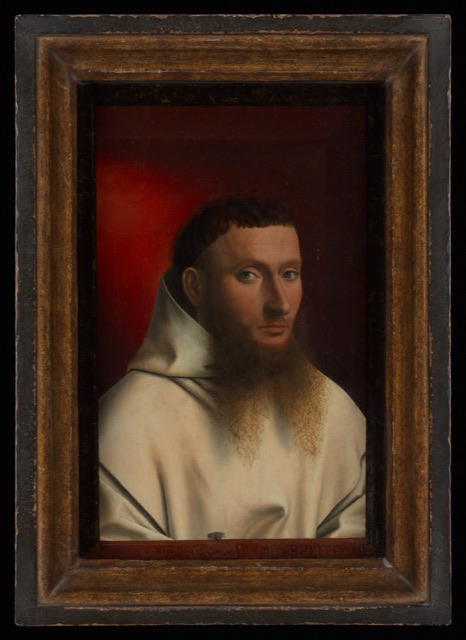
Look at the ledge at the bottom of the picture, just above the lettering. A fly has landed there. It is painted at life size, as if it were sitting on the frame and not in the picture at all. Petrus Christus signed and dated this portrait in Bruges in fourteen forty-six. The sitter is a Carthusian, a member of a silent monastic order, and he looks straight back at us.
A closer look
Notice the light. It falls from the left onto the man’s face and white habit, and a second, redder glow fills the corner of the room behind him. Earlier portraits in the Netherlands set their sitters against plain darkness. Here, for one of the first times, a person is placed in a real corner of space. The lettering on the ledge reads, in Latin, Petrus Christus made me, with the year. Christus was the leading painter in Bruges after the death of Jan van Eyck, and he learned from van Eyck’s example how oil paint could describe each hair of a beard and each fold of wool. The beard marks the sitter as a lay brother, who served the monastery without taking a priest’s vows. Now find the fly again. It may be a boast about the painter’s skill, or a reminder that life is short.
A lay brother of the Carthusian order looks out from a corner of red-lit space. On the painted ledge below him are the artist’s signature, the year 1446, and a single fly. Oil on oak; the panel is 29.2 × 21.6 cm and is shown here in its frame.
Stop 3 of 5 · Domenico Ghirlandaio (Domenico Bigordi) · ca. 1488
Francesco Sassetti (1421–1490) and His Son Teodoro
First Look
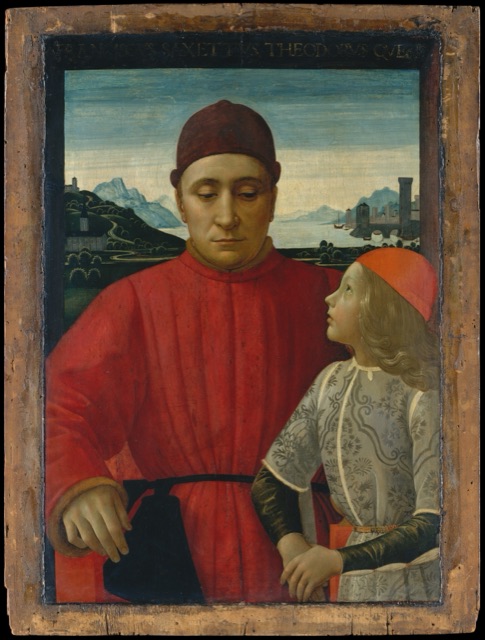
Look at the boy’s face, turned up toward his father. The father does not look back. His eyes are lowered, and the child’s two hands are folded over his arm. This is Francesco Sassetti, manager of the Medici bank in Florence, with his son Teodoro. Domenico Ghirlandaio painted them around fourteen eighty-eight. Their names are written in Latin along the top edge.
A closer look
Compare the two heads. The father’s is broad and still, painted almost like a sculpture. The boy’s is all fine detail: the curls, the patterned silk, the upturned eye. Ghirlandaio ran the busiest workshop in Florence, and Sassetti was one of his best clients. A few years earlier the painter had covered the walls of the family’s chapel in the church of Santa Trinita with scenes that include the banker and his children. The boy’s name carries a story. An older son called Teodoro died in fourteen seventy-nine, and this child, born the same year, was given his name. That birth date is how the picture is dated. By then the bank was in serious trouble, and Sassetti’s own fortune with it. Nothing of that shows here. Behind them, a road winds down to calm water.
Francesco Sassetti, manager of the Medici bank, stands with his young son Teodoro in front of a landscape of hills and water. The father looks down and the boy looks up, and their names run across the top in Latin. Tempera on wood, 84.5 × 63.8 cm.
Stop 4 of 5 · Hans Holbein the Younger · 1532
Hermann von Wedigh III (died 1560)
First Look
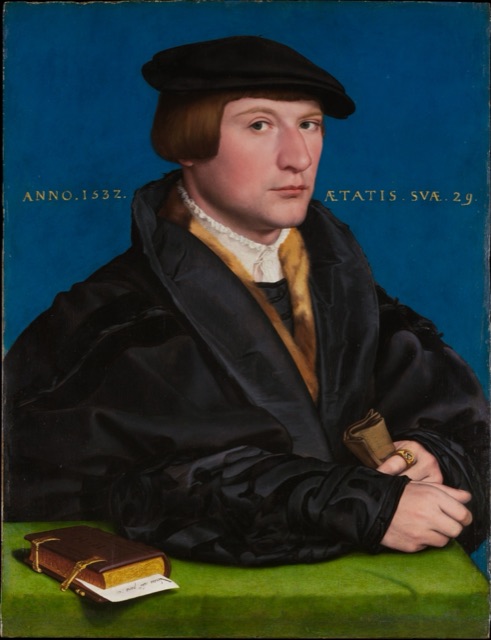
Look at the slip of paper tucked into the book on the table. A few words of Latin are written on it, small enough to make you lean in. Hans Holbein painted this merchant in London in fifteen thirty-two. The gold letters on either side of his head give the year and the sitter’s age, twenty-nine. He came from Cologne, and his look is level and unhurried.
A closer look
Notice the blue behind the sitter. It is flat, with no room and no shadow, so the fur, the black satin and the face stand out like objects laid on a cloth. Holbein had come to London from Basel, and his first steady clients there were German merchants of the Hanseatic League, who lived and traded together in a walled compound by the Thames called the Steelyard. Hermann von Wedigh belonged to a Cologne family in that trade. On his finger is a ring with his family’s arms, and his shortened name is written on the edge of the book. The Latin on the slip of paper is a line from the Roman playwright Terence: truth breeds hatred. Why he chose it is not recorded. Within a few years Holbein was painting the king, Henry the Eighth, and his court.
A merchant from Cologne, twenty-nine years old, sits behind a green table in London, where German traders of the Hanseatic League kept their own trading house. The year and his age are lettered in gold across the blue ground. Oil and gold on oak, 42.2 × 32.4 cm.
Stop 5 of 5 · Bronzino (Agnolo di Cosimo di Mariano) · 1530s
Portrait of a Young Man
First Look
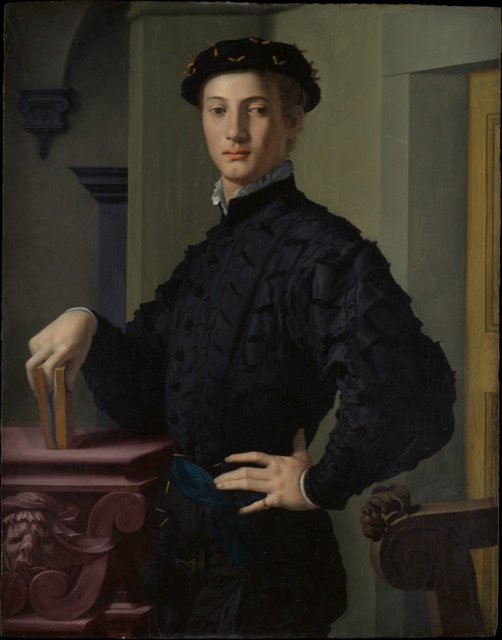
Look at the carved face on the table, under the young man’s book, and then find the second one on the arm of the chair. Both are grimacing. Above them the sitter keeps a perfectly composed expression, one hand on his hip and the other holding his place in a book. Bronzino painted him in Florence in the fifteen thirties. Nobody knows his name.
A closer look
Notice the young man’s eyes. One looks at us and the other drifts very slightly outward, and Bronzino has recorded that without correcting it. Everything else is control: the black satin slashed in rows, the long fingers, the cool grey architecture. The sitter was probably one of the painter’s literary friends. Bronzino wrote poetry himself, and the book is a sign of that shared world. The carved masks on the furniture may be a private joke about faces and disguises, set beside a face that gives nothing away. Examination of the panel has shown that Bronzino changed his mind as he worked, altering the architecture behind the figure. He went on to become court painter to the Medici dukes, and his portraits set the pattern for how the rulers of Florence wished to be seen.
An unnamed young Florentine, book in hand, poses with studied ease between a table and a chair carved with grotesque faces. Bronzino later became court painter to the Medici dukes. Oil on wood, 95.6 × 74.9 cm.
ca. 1440Portrait of a Woman with a Man at a Casement
A woman in profile stands in a small room while a man looks in at the window, his hands resting on a coat of arms. This is the earliest surviving double portrait in Italian painting, and the first to place its sitters indoors. Tempera on wood, 64.1 × 41.9 cm.
1446Portrait of a Carthusian
A lay brother of the Carthusian order looks out from a corner of red-lit space. On the painted ledge below him are the artist’s signature, the year 1446, and a single fly. Oil on oak; the panel is 29.2 × 21.6 cm and is shown here in its frame.
ca. 1488Francesco Sassetti (1421–1490) and His Son Teodoro
Francesco Sassetti, manager of the Medici bank, stands with his young son Teodoro in front of a landscape of hills and water. The father looks down and the boy looks up, and their names run across the top in Latin. Tempera on wood, 84.5 × 63.8 cm.
1532Hermann von Wedigh III (died 1560)
A merchant from Cologne, twenty-nine years old, sits behind a green table in London, where German traders of the Hanseatic League kept their own trading house. The year and his age are lettered in gold across the blue ground. Oil and gold on oak, 42.2 × 32.4 cm.
1530sPortrait of a Young Man
An unnamed young Florentine, book in hand, poses with studied ease between a table and a chair carved with grotesque faces. Bronzino later became court painter to the Medici dukes. Oil on wood, 95.6 × 74.9 cm.
Other exhibitions
The Sistine Chapel: Ceiling, Altar, and Wall Cycles
Michelangelo’s ceiling and Last Judgment alongside the fifteenth-century north and south wall narratives by Botticelli, Perugino, Ghirlandaio, Rosselli, and Signorelli.
1765–1857 · 7 worksEdo: Pictures of the Floating World
Seven woodblock prints from the city of Edo, 1765 to 1857: Harunobu, Kiyonaga, Sharaku, Utamaro and Hiroshige, from the Art Institute of Chicago.
1867–1893 · 7 worksImpressionism: Painters of Modern Life
Seven painters and seven views of modern France, 1867 to 1893: Monet, Renoir, Morisot, Caillebotte, Degas, Cassatt and Pissarro, from the Art Institute of Chicago.
1782–1893 · 6 worksFrom Edo to Paris: Ukiyo-e and the Impressionist Eye
How Japanese woodblock masters Hiroshige and Kiyonaga inspired the cropped framing, asymmetric diagonals, and rain-swept streets of Caillebotte, Degas, and Cassatt.