Portrait of a Carthusian
Stop 1 · First look
First Look
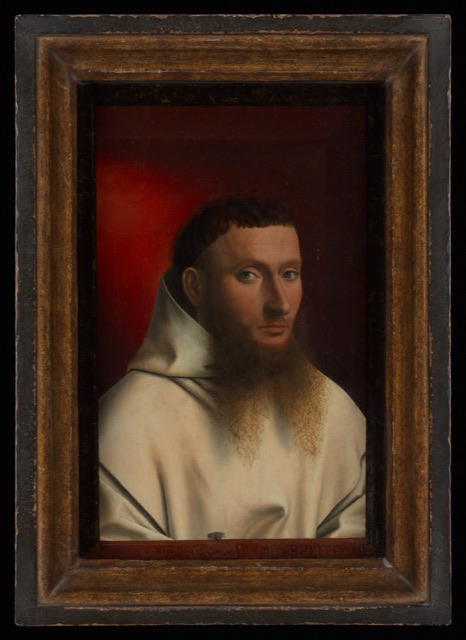
Look at the ledge at the bottom of the picture, just above the lettering. A fly has landed there. It is painted at life size, as if it were sitting on the frame and not in the picture at all. Petrus Christus signed and dated this portrait in Bruges in fourteen forty-six. The sitter is a Carthusian, a member of a silent monastic order, and he looks straight back at us.
Stop 2 · Technique
Closer Reading
Notice the light. It falls from the left onto the man’s face and white habit, and a second, redder glow fills the corner of the room behind him. Earlier portraits in the Netherlands set their sitters against plain darkness. Here, for one of the first times, a person is placed in a real corner of space. The lettering on the ledge reads, in Latin, Petrus Christus made me, with the year. Christus was the leading painter in Bruges after the death of Jan van Eyck, and he learned from van Eyck’s example how oil paint could describe each hair of a beard and each fold of wool. The beard marks the sitter as a lay brother, who served the monastery without taking a priest’s vows. Now find the fly again. It may be a boast about the painter’s skill, or a reminder that life is short.
Stop 3 · Museum record
Catalog Summary
A lay brother of the Carthusian order looks out from a corner of red-lit space. On the painted ledge below him are the artist’s signature, the year 1446, and a single fly. Oil on oak; the panel is 29.2 × 21.6 cm and is shown here in its frame.
Recorded physical scale: 26.0 × 36.2 cm (10.3 × 14.3 in · 0.26 × 0.36 m).
Stop 4 · Historical Context
Petrus Christus (c. 1410–c. 1476)
Painter who carried on Jan van Eyck's manner in Bruges and was one of the first to set a portrait sitter inside a room.
Northern Renaissance (about 1430 to 1600): The art of the Low Countries and the German lands in the 15th and 16th centuries, known for oil painting and close, exact observation of the visible world.
First Look
Look at the ledge at the bottom of the picture, just above the lettering. A fly has landed there. It is painted at life size, as if it were sitting on the frame and not in the picture at all. Petrus Christus signed and dated this portrait in Bruges in fourteen forty-six. The sitter is a Carthusian, a member of a silent monastic order, and he looks straight back at us.
Closer Reading
Notice the light. It falls from the left onto the man’s face and white habit, and a second, redder glow fills the corner of the room behind him. Earlier portraits in the Netherlands set their sitters against plain darkness. Here, for one of the first times, a person is placed in a real corner of space. The lettering on the ledge reads, in Latin, Petrus Christus made me, with the year. Christus was the leading painter in Bruges after the death of Jan van Eyck, and he learned from van Eyck’s example how oil paint could describe each hair of a beard and each fold of wool. The beard marks the sitter as a lay brother, who served the monastery without taking a priest’s vows. Now find the fly again. It may be a boast about the painter’s skill, or a reminder that life is short.
Catalog Summary
A lay brother of the Carthusian order looks out from a corner of red-lit space. On the painted ledge below him are the artist’s signature, the year 1446, and a single fly. Oil on oak; the panel is 29.2 × 21.6 cm and is shown here in its frame.
About the Artist
Petrus Christus (c. 1410–c. 1476)
Petrus Christus came from Baarle, in the old duchy of Brabant. His birth year is not recorded: estimates run from about 1410 to 1420. Nobody knows who taught him. The first record of him dates from 1444, when he became a citizen of Bruges so that he could work there as a painter. Jan van Eyck had died three years earlier.
He borrowed designs and whole compositions from van Eyck and made them simpler, and he also learned from Rogier van der Weyden. Nine of his surviving paintings are signed and dated, all between 1446 and 1457. One of the earliest is the portrait of a Carthusian lay brother, painted in oil on oak in 1446. In his portraits he swapped the plain background for the inside of a room.
His clients were Bruges families and merchants from Italy and Spain. In 1463 he helped to direct two huge street decorations for the entry of Duke Philip the Good into Bruges. He died in Bruges between September 1475 and March 1476. His son Bastiaen probably took over the workshop.